
NEET High-Yield Topic Explorer
Click on a subject or specific topic below to reveal detailed analysis, expected question counts, and strategic advice for maximizing your score.
Exam Metrics
- Avg. Questions (5 Yrs)
- Difficulty Level
Strategic Insight
💡 Action Plan Tip
Think you can ace NEET by studying everything equally? Think again. The exam doesn't care about your effort; it cares about where that effort lands on the answer sheet. With over two million aspirants fighting for roughly one lakh seats, treating every chapter with equal importance is a strategy guaranteed to leave you short of the cutoff.
Here’s the hard truth: not all chapters are created equal. Some topics carry disproportionate weight in the marking scheme. If you master these "high-yield" areas, you secure the bulk of your score with less time investment. This guide breaks down exactly which subjects and specific chapters dominate the paper, so you stop wasting hours on low-return topics.
The Biology Powerhouse: Where the Marks Hide
If you’re looking for the single most important subject, look no further than Biology. It accounts for 50% of the total score (360 out of 720 marks). But here’s the twist: within Biology, the weight isn’t split evenly between Botany and Zoology, nor is it spread evenly across chapters.
Focus heavily on Human Physiology. In recent years, this section has consistently contributed 18-22 questions per year. Why? Because it tests application, not just rote memory. Questions on digestion, respiration, and neural control require you to understand processes, making them distinct from simple factual recall.
Next up is Genetics and Evolution. This is often considered the hardest part of Biology, but it’s also the most scoring if you get the logic right. Expect 10-14 questions here. Mastering Mendelian principles, pedigree analysis, and DNA replication mechanisms gives you a massive edge because these questions are objective and have clear right answers, unlike ambiguous theoretical questions.
| Chapter | Avg. Questions (Last 5 Years) | Difficulty Level | Priority Status |
|---|---|---|---|
| Human Physiology | 18-22 | Moderate-High | Critical |
| Genetics & Evolution | 10-14 | High | Critical |
| Plant Physiology | 12-15 | Moderate | High |
| Ecology | 10-12 | Low-Moderate | High |
| Biotechnology | 6-8 | High | Medium |
Don’t ignore Ecology. It’s the easiest way to bank 10+ marks. The concepts are straightforward, and the NCERT diagrams are frequently reproduced directly in the question paper. If you’re struggling with Physics, Ecology is your safety net.
Chemistry: The Scoring Bridge Between Subjects
Many students treat Chemistry as a backup subject, but it’s actually the bridge between the conceptual depth of Physics and the memorization-heavy nature of Biology. Out of 90 questions, Organic Chemistry holds the crown for consistency.
Why Organic? Because once you understand the mechanisms-like electrophilic substitution or nucleophilic addition-you can solve any question thrown at you. It’s logical, not random. Expect 15-18 questions from Organic Chemistry alone. Topics like Hydrocarbons, Alcohols, and Biomolecules are non-negotiable.
Inorganic Chemistry is pure memory, but it’s quick to revise. Focus on Coordination Compounds and Periodic Properties. These two chapters alone can fetch you 8-10 marks. They appear every single year without fail. If you hate memorizing tables, this might be painful, but skipping them is suicide for your rank.
Physical Chemistry is tricky. It’s calculation-based, similar to Physics. However, topics like Mole Concept and Electrochemistry are formula-driven. Once you learn the formulas, the questions are repetitive. Don’t spend weeks mastering complex thermodynamics derivations; focus on applying standard formulas quickly.
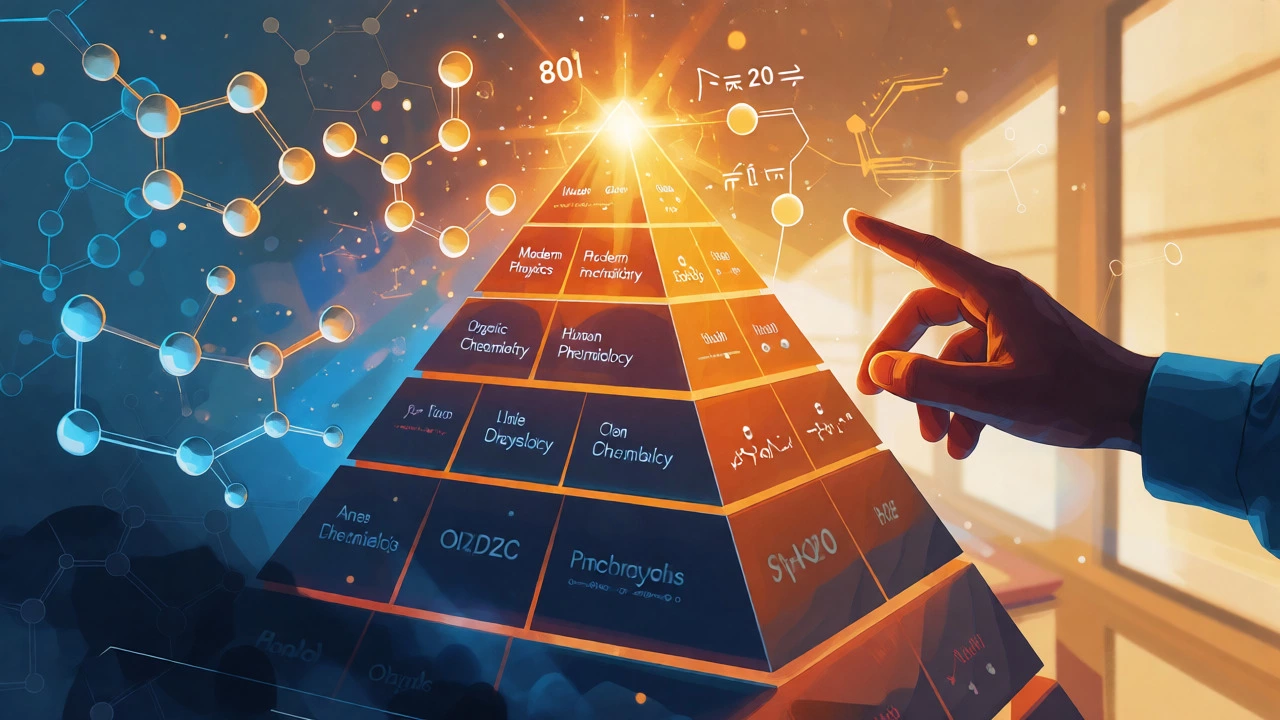
Physics: Quality Over Quantity
Let’s be honest: Physics scares most NEET aspirants. But here’s the secret-it’s not about solving the hardest problems; it’s about picking the right ones. Physics contributes 45 questions, but many are direct formula applications.
The highest yield area in Physics is Modern Physics. This includes atoms, nuclei, and dual nature of radiation. These topics overlap significantly with Chemistry and require less mathematical heavy lifting than Mechanics. Expect 8-10 questions from this cluster. They are often statement-based and can be solved in under a minute each.
Next, tackle Current Electricity and Optics. Current Electricity involves circuit diagrams that follow strict rules (Kirchhoff’s laws). Once you practice enough, you’ll recognize patterns instantly. Optics is geometric and visual; if you draw the ray diagrams correctly, the math is trivial.
Avoid spending excessive time on rotational mechanics if you’re weak in math. It’s conceptually tough and rarely yields more than 2-3 direct questions. Instead, ensure you nail Semiconductors. It’s a small chapter, but it guarantees 2-3 easy marks every year. Logic gates and diode characteristics are favorites of the examiners.
Strategic Weightage Analysis: The 80/20 Rule
You don’t need to know 100% of the syllabus to get a top rank. You need to know the critical 20% that generates 80% of the questions. Let’s look at the data from the last five NEET papers to see what really matters.
- Top 5 High-Yield Topics: Human Physiology, Genetics, Organic Chemistry, Modern Physics, Ecology.
- Marks Potential: Mastering just these five areas can secure you approximately 180-200 marks.
- Time Investment: These topics take roughly 40% of your study time but deliver 50% of your score.
Compare this to low-yield topics like Thermodynamics in Physics or Structural Organization in Animals in Biology. While important, they contribute fewer questions relative to the time required to master them. Study them, but don’t obsess over obscure sub-topics within them.
Common Mistakes That Waste Your Score
Most students fail not because they didn’t study, but because they studied the wrong things. Here are three traps to avoid:
- Neglecting NCERT Line-by-Line: For Biology and Inorganic Chemistry, the exam paper is literally lifted from NCERT textbooks. If you rely solely on coaching notes, you miss crucial lines. Read the NCERT text for Biology and Inorganic Chemistry until you can recite it.
- Ignoring Previous Year Questions (PYQs): Patterns repeat. A topic ignored in 2023 might return in 2026. Solving PYQs reveals the examiner’s mindset. Do not skip the last 10 years’ papers.
- Over-Studying Weak Areas: If you hate Physics, don’t try to become an expert in Rotational Motion. Aim for average performance there and maximize your score in Biology and Chemistry. Rank is determined by your total, not your weakest link.
Action Plan: How to Prioritize Your Study Schedule
So, how do you structure your day? Start with the heaviest hitters.
Morning (Fresh Mind): Tackle Physics numericals. Your brain is sharpest for calculations. Focus on Modern Physics and Current Electricity first.
Afternoon (Active Learning): Dive into Organic Chemistry mechanisms. Drawing reaction chains keeps you engaged and prevents drowsiness.
Evening (Retention Mode): Read Biology NCERT. Passive reading works well when energy levels dip. Focus on Human Physiology and Genetics diagrams.
Remember, consistency beats intensity. Studying 4 hours daily on high-yield topics will outperform 10 hours of scattered study on low-priority chapters.
Which subject has the highest weightage in NEET?
Biology has the highest weightage, accounting for 50% of the total marks (360 out of 720). Within Biology, Human Physiology and Genetics are the most significant chapters.
Is Organic Chemistry harder than Physical Chemistry for NEET?
It depends on your aptitude. Organic Chemistry requires understanding mechanisms and logic, while Physical Chemistry requires mathematical accuracy. However, Organic Chemistry has higher consistency in question patterns, making it more predictable and often easier to score in once mastered.
Can I skip difficult Physics chapters like Rotation?
You shouldn't skip them entirely, but you shouldn't prioritize them over high-yield topics like Modern Physics or Semiconductors. Aim to cover the basics of Rotation to grab easy questions, but don't spend weeks mastering complex problems unless you are aiming for a top 100 rank.
How many questions come from NCERT Biology diagrams?
Approximately 10-15 questions in NEET Biology are directly based on NCERT diagrams, flowcharts, or tables. Memorizing these visual aids is one of the fastest ways to increase your score.
Which Chemistry chapter is easiest to score in?
Inorganic Chemistry, specifically Periodic Properties and Coordination Compounds, is often considered the easiest to score in because it relies on factual knowledge rather than complex calculations or multi-step reasoning.