
Coding vs Programming Skill Analyzer
Select scenarios below that match your current interests or tasks. The analyzer will determine if you're leaning more towards coding or programming.
Task Scenarios
Your Profile
Have you ever heard someone say they are learning to code, only to find out they actually mean they are studying computer science? It happens all the time. The words coding and programming get thrown around interchangeably in job postings, social media posts, and casual conversations. But if you are looking to start a career in tech or enroll in coding classes, understanding the distinction is crucial.
Think of it this way: coding is like translating sentences from English into French. You take specific instructions and convert them into a language a computer understands. Programming, on the other hand, is like writing the entire book. It involves planning the plot, developing characters, structuring chapters, and then doing the translation. One is a subset of the other, but they require different mindsets and skill sets.
The Core Distinction: Translation vs. Problem Solving
To really grasp the difference, we need to look at what each activity actually entails. When you are coding, you are focusing on syntax and structure. You are writing lines of code in languages like Python, JavaScript, or C++ to make a specific function work. If I ask you to write a loop that prints numbers from one to ten, you are coding. You are following a set rule to achieve a direct output.
Programming, however, is about logic and architecture. Before you write a single line of code, a programmer has to figure out how the application should behave. They design algorithms, choose data structures, and plan how different parts of the system will talk to each other. A programmer asks, "How do I build a system that can handle thousands of users simultaneously without crashing?" That requires deep problem-solving skills that go far beyond just knowing the syntax of a language.
In short, coding is the act of writing the code. Programming is the process of creating the solution.
A Real-World Analogy: Building a House
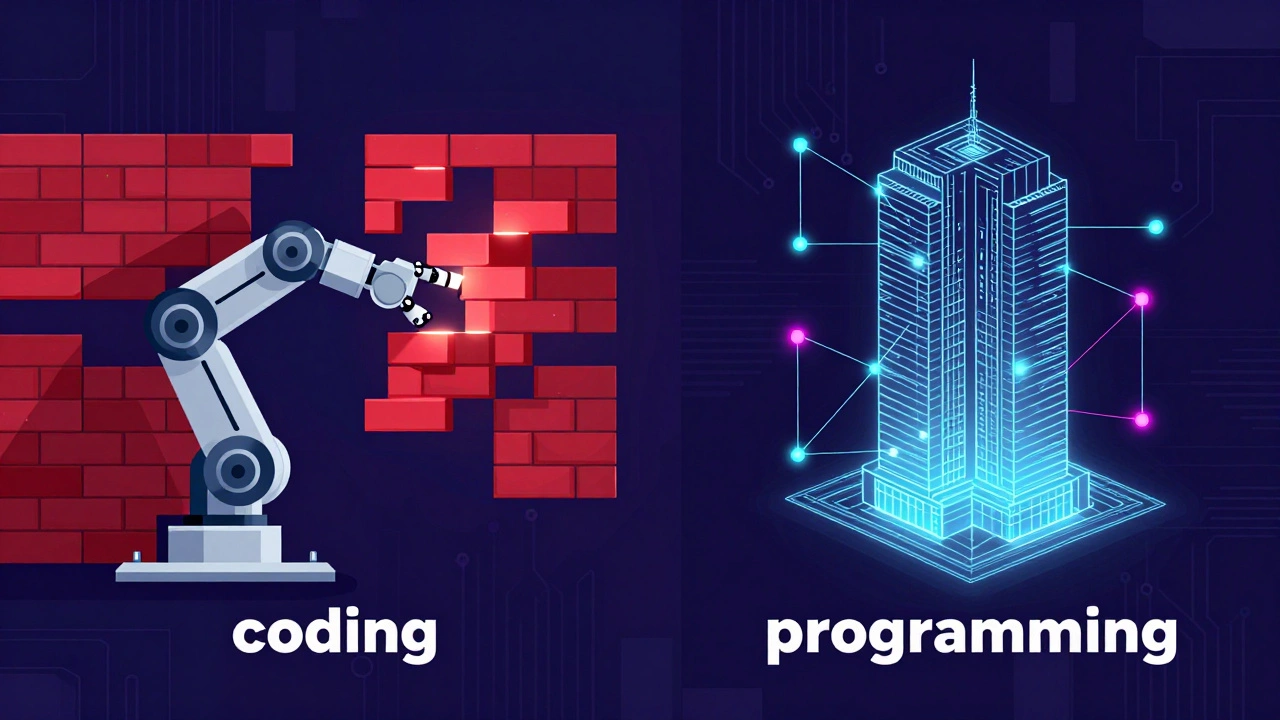
Analogies help clarify abstract concepts. Imagine you are building a house. Coding is similar to laying bricks. You follow the blueprint exactly as instructed. You place brick A next to brick B. If you do this correctly, the wall stands up. It’s precise, technical, and repetitive. If you know how to lay bricks efficiently, you are a good coder.
Programming is like being the architect and the general contractor. You have to decide where the walls go, how many rooms there are, and whether the foundation can support the roof. You have to consider the budget, the timeline, and the materials. You might hire people to lay the bricks (code), but you are responsible for the entire structure. If the house collapses, it wasn’t because the bricks were laid wrong; it was because the design was flawed.
This analogy explains why some people can be great coders but struggle with programming tasks. They can execute instructions perfectly but lack the broader vision needed to design complex systems.
| Aspect | Coding | Programming |
|---|---|---|
| Focus | Syntax and implementation | Logic and system design |
| Scope | Narrow and specific | Broad and holistic |
| Skills Required | Knowledge of programming languages | Algorithmic thinking, debugging, architecture |
| Output | Lines of code | Functional software applications |
| Complexity | Lower barrier to entry | Higher cognitive load |
Why This Matters for Your Career Path
If you are deciding between taking coding classes or pursuing a degree in computer science, this distinction guides your choice. Many bootcamps focus heavily on coding. They teach you how to use React, Vue, or Django. They show you how to write clean, efficient code for specific tasks. This is valuable if you want to become a front-end developer or a junior backend engineer quickly.
However, if you aim to become a senior software engineer, a solutions architect, or a tech lead, you need programming skills. These roles require you to solve ambiguous problems. You won’t always have a clear instruction manual. You will need to break down large, vague requirements into manageable pieces. This is where algorithmic thinking and data structure knowledge come into play. Without these foundational programming concepts, you might hit a ceiling in your career growth.
Employers often look for both. They want candidates who can write clean code (coding) but also understand why that code fits into the larger system (programming). In interviews, you might be asked to write a function to reverse a string (coding test) and then explain how that function impacts memory usage in a large-scale application (programming question).
The Learning Curve: From Syntax to Strategy
Starting with coding is easier. There are countless online resources, tutorials, and platforms like Codecademy or freeCodeCamp that guide you through syntax. You can see immediate results. You type a command, and something happens on the screen. This instant feedback loop is addictive and encouraging for beginners.
Learning to program takes longer. It requires patience and practice. You might spend days designing an algorithm only to realize it’s inefficient. You’ll encounter bugs that aren’t syntax errors but logical flaws. Debugging a logical error is harder than fixing a missing semicolon. It forces you to think critically about every step of the process. This is why many students find computer science courses challenging-they are not just teaching you a language; they are teaching you how to think.
As you progress, the two merge. Experienced developers don’t separate coding from programming anymore. They write code while constantly thinking about the architecture. They refactor code to improve performance. They balance quick fixes with long-term maintainability. The best developers are those who can switch seamlessly between the detailed view of coding and the big-picture view of programming.
Tools and Technologies Involved
The tools you use also reflect the difference. For coding, you primarily use Integrated Development Environments (IDEs) like Visual Studio Code or PyCharm. You rely on documentation, stack overflow answers, and language-specific libraries. Your success depends on how well you know the tools of your trade.
For programming, you use additional tools for design and management. You might use UML diagrams to map out object relationships. You use version control systems like Git not just to save code, but to manage branches and merges in a collaborative environment. You use testing frameworks like Jest or PyTest to ensure your logic holds up under various conditions. These tools support the broader engineering process rather than just the act of typing code.

Common Misconceptions
A common myth is that coding is less intellectual than programming. This is false. Writing efficient, secure, and readable code requires deep knowledge. A bad coder can create security vulnerabilities or slow down an entire application. Another misconception is that programming doesn’t require hands-on coding. While architects may write less code, they must still understand it deeply to make informed decisions. You cannot design what you do not understand.
Another misunderstanding is that you must choose one over the other. You don’t. Every programmer codes, and every coder benefits from programming principles. The key is recognizing which skill you need to develop more. If you struggle with syntax, focus on coding exercises. If you struggle with designing solutions, focus on algorithm challenges and system design case studies.
Getting Started: Practical Steps
If you are new to this field, here is a practical roadmap. Start by picking one language. Python is great for beginners because its syntax is close to plain English. JavaScript is essential if you want to build websites. Spend the first few months mastering the basics: variables, loops, functions, and conditionals. This is your coding foundation.
Once you are comfortable, move to small projects. Build a calculator, a to-do list, or a simple blog. As you build, try to think about structure. How would you add a new feature? How would you store user data? This shifts your mindset from coding to programming. Join communities, read other people’s code, and learn how experienced developers structure their projects.
Consider enrolling in structured coding classes or bootcamps if you prefer guided learning. Look for programs that emphasize project-based learning. Avoid courses that only teach syntax without context. The goal is to build a portfolio that demonstrates both your ability to write code and your capacity to solve problems.
Can I become a software engineer without knowing how to code?
No, coding is the fundamental skill required for software engineering. While programming involves higher-level thinking, you must be able to implement your ideas through code. However, you can start with basic coding skills and develop programming expertise over time.
Is coding easier than programming?
Coding is generally easier to learn initially because it focuses on syntax and specific rules. Programming is more challenging as it requires abstract thinking, problem-solving, and system design. However, both require continuous learning and practice.
Do I need a computer science degree to learn programming?
Not necessarily. Many successful programmers are self-taught or learned through bootcamps and online courses. However, a computer science degree provides a strong theoretical foundation in algorithms, data structures, and system design, which are core aspects of programming.
Which should I learn first: coding or programming?
You should start with coding. Learning the syntax and basic constructs of a programming language gives you the tools to express your ideas. Once you are comfortable with coding, you can begin applying programming principles to solve more complex problems.
Are coding classes worth it for beginners?
Yes, coding classes can provide structured learning, mentorship, and community support. They help beginners avoid common pitfalls and accelerate their learning curve. Choose classes that offer hands-on projects and real-world scenarios to bridge the gap between coding and programming.