
Beginner ESL Lesson Planner
Select your lesson focus and target audience to generate a recommended activity structure and time allocation based on best practices for beginner ESL instruction.
Select options and click "Generate" to see the recommended approach.
Quick Reference: Teaching Methods Matrix
Best For:
Concrete nouns (objects)
Action: Show actual object, name it.
Best For:
Visual learners, review
Action: Hide card, reveal slowly.
Best For:
Verbs, commands
Action: Model action + word.
Best For:
Abstract concepts
Action: Use sentence + gesture.
You walk into a room full of adults or children who don't speak your language. You say "Hello," and they stare back. Silence. Panic sets in. This is the reality for most new ESL teachers starting their journey with absolute beginners. It’s not just about knowing grammar rules; it’s about making those rules stick when you can’t explain them in the student's native tongue.
Teaching English as a second language to novices requires a specific toolkit. You aren't just transmitting information; you're building a bridge between two worlds. If you’re looking for how to teach English for beginners effectively, you need to focus on clarity, repetition, and low-stress environments. Forget complex lectures. Your goal is simple communication.
Mastering Classroom Presence and Simplicity
The biggest mistake new teachers make is talking too much. Beginners cannot process rapid-fire native speech. They need time to decode sounds and meanings. If you speak at normal speed, you lose them in the first ten seconds.
Adopt the "less is more" philosophy. Use short sentences. Subject-Verb-Object. That’s it. Instead of saying, "Could you please open your books to page forty-two?", try this: "Open your books." Pause. Point to the book. Gesture clearly. Wait. Let them figure it out. This technique, often called TPR (Total Physical Response), links language to action. When you say "stand up" and stand up yourself, the meaning becomes obvious without translation.
Your body language is your second voice. Smile. Nod. Use exaggerated facial expressions. If a student makes a mistake, don’t frown. Frowning creates anxiety, and anxiety blocks learning. Keep the vibe positive. Beginners are vulnerable. They feel foolish when they can’t express basic needs. Your job is to make them feel safe enough to try again.
Building Vocabulary Through Visuals and Context
Vocabulary is the foundation of any language. Without words, grammar is useless. But how do you teach words to someone who doesn't know what you're saying? You show them.
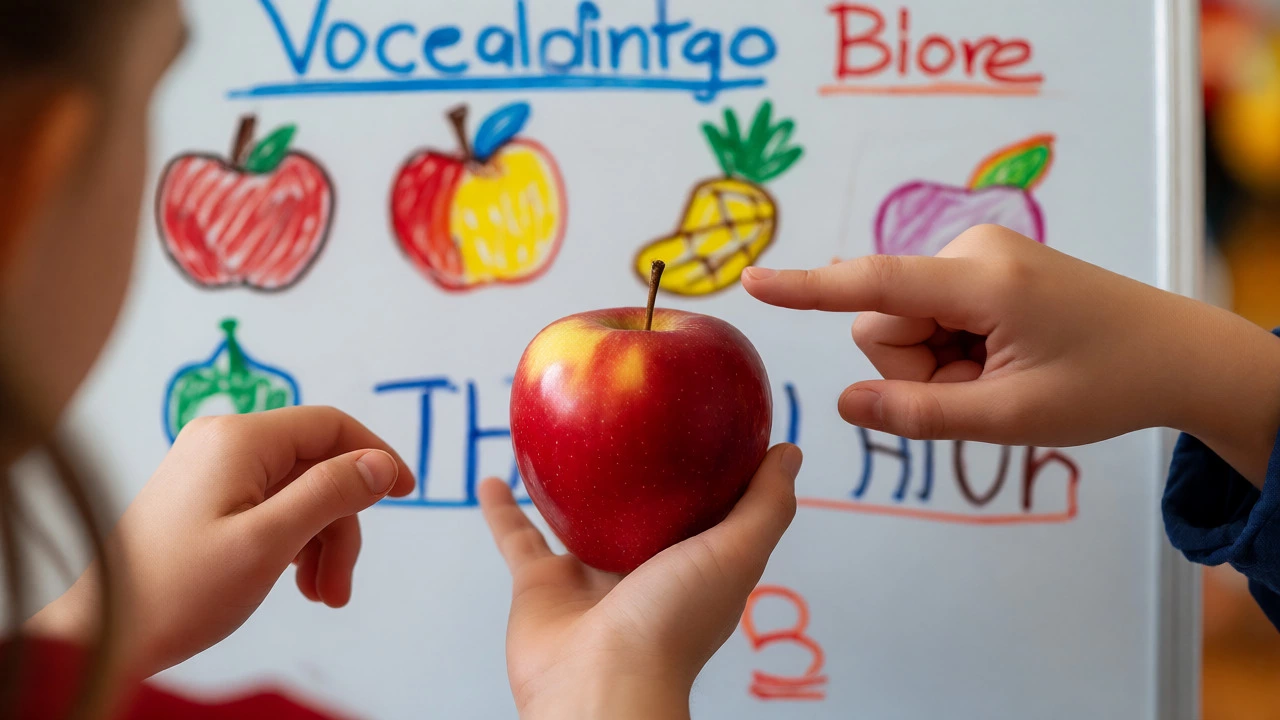
Use realia-real objects. Bring an apple to class. Hold it up. Say "Apple." Have students repeat it. Pass it around. Ask, "Is this an orange?" Shake your head. "No. Apple." This concrete association sticks far better than abstract definitions. For abstract concepts like "happy" or "sad," use pictures or mime. Draw faces on the board. Act it out.
Don't overwhelm them. Five to seven new words per lesson is plenty. More than that, and they’ll forget everything by tomorrow. Group words by theme. Food colors, family members, daily actions. Thematic clusters help the brain organize information. Once they know five food words, practice ordering food. Context turns passive vocabulary into active skill.
| Method | Best For | Teacher Action | Student Outcome |
|---|---|---|---|
| Realia | Concrete nouns (objects) | Show actual object, name it | Direct sensory association |
| Flashcards | Visual learners, review | Hide card, reveal slowly | Quick recall recognition |
| TPR | Verbs, commands | Model action + word | Muscle memory connection |
| Context Clues | Abstract concepts | Use sentence + gesture | Inferential understanding |
Introducing Grammar Without the Jargon
Do not write "Present Simple Tense" on the board. The term means nothing to a beginner. Teach the pattern, not the label. Show them how to form sentences using templates.
Start with "I am..." and "I have..." These are high-frequency structures. Write a formula on the board: [Subject] + [Verb] + [Object]. Give examples. "I eat apples." "She drinks water." Then, let them swap parts. "You drink coffee." "He eats pizza." This scaffolding approach gives them confidence. They aren't guessing; they are following a rule they can see.
Correct errors gently. If a student says, "I go to school yesterday," don't stop them mid-sentence. Let them finish. Then, recast the correction. "Ah, you went to school yesterday." Repeat the correct form naturally. This preserves their flow while modeling accuracy. Over-correction kills motivation. Focus on comprehensibility first, accuracy later.
Designing Low-Stress Speaking Activities
Beginners are terrified of speaking. They fear judgment. To get them talking, lower the stakes. Pair work is safer than whole-class speaking. In pairs, one person might be shy, but they still have to participate. It’s less exposing than standing alone in front of twenty peers.
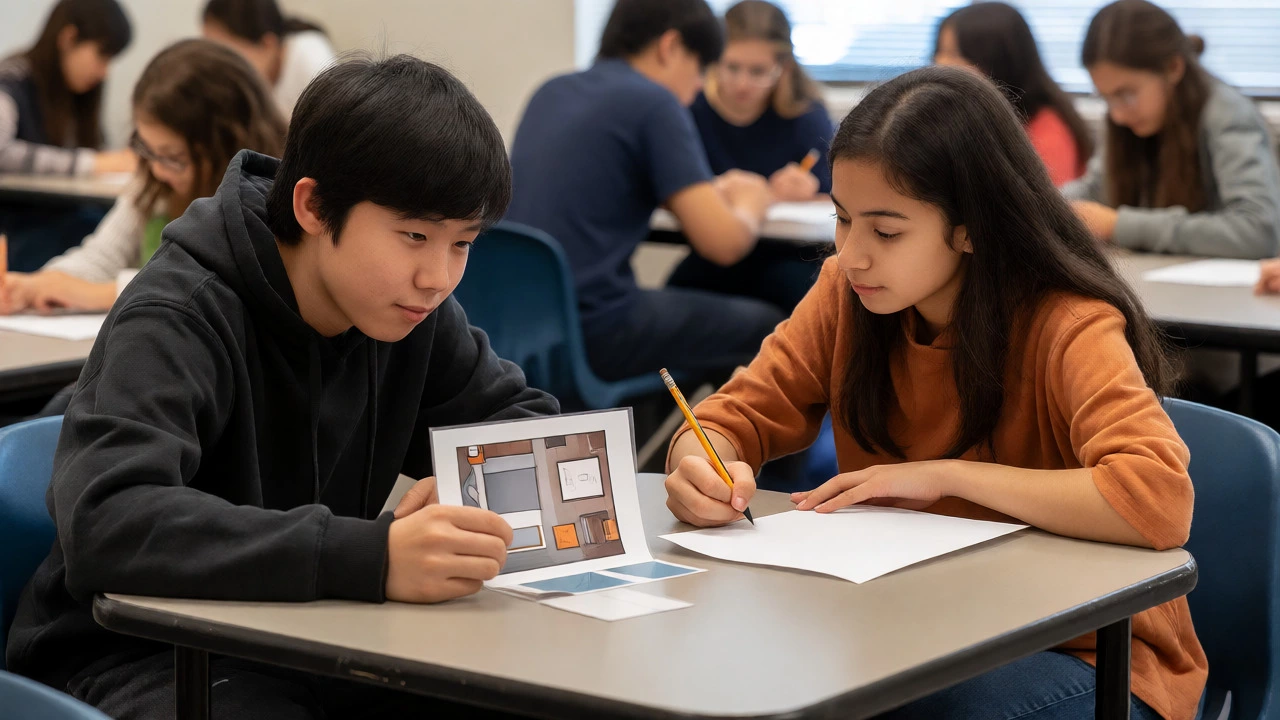
Use information gap activities. Student A has a picture of a bedroom. Student B has a blank version. Student A describes: "The bed is next to the window." Student B draws it. They compare results. This forces communication because there’s a genuine reason to talk-you need to complete the task. It’s not just drilling; it’s doing.
Choral repetition helps too. Everyone speaks together. No one stands out. It builds muscle memory for pronunciation. Once they feel comfortable saying words in a group, ask individuals to try. Start with the confident ones, then move to the quieter students. Never force a student to speak if they aren't ready. Observation is also learning.
Assessment and Feedback Strategies
How do you know they’re learning? Tests scare beginners. Avoid formal exams early on. Use observation instead. Walk around during pair work. Listen. Note common mistakes. Did everyone struggle with the "th" sound? Address it next class. Did half the class confuse "he" and "she"? Review pronouns.
Give feedback privately when possible. Public correction can be embarrassing. A quick whisper, "Good try, but remember 'went' not 'go'," works wonders. Celebrate small wins. If a student successfully orders a coffee in role-play, praise them specifically. "Great job using 'please' and 'thank you'." Specific praise reinforces good habits.
Track progress visually. A simple checklist on the wall: "Can introduce self," "Can count to 10," "Can name colors." Students love ticking boxes. It shows tangible progress in a subject where improvement feels slow and invisible.
Common Pitfalls to Avoid
New teachers often rely too heavily on translation. While occasional translation saves time, overusing it prevents immersion. If you translate every word, students wait for the translation instead of listening to the English. Try to define words in English first. Use synonyms, gestures, or pictures. Only translate if they truly look lost.
Another trap is ignoring cultural context. Language isn't just words; it's culture. Explain why we shake hands, or why we say "bless you" after a sneeze. These social cues matter as much as grammar. Beginners often miss these nuances, leading to awkward interactions outside the classroom.
Finally, don't neglect homework. But keep it light. Ten minutes of flashcard practice or writing three sentences about their day. Heavy homework burdens discourage busy adults or tired kids. Consistency beats intensity. Small daily touches build fluency faster than weekend cramming.
Frequently Asked Questions
How long does it take to teach a beginner basic conversation?
With consistent practice (2-3 times a week), most beginners can handle basic introductions and simple requests within 3 to 6 months. Progress depends on exposure outside class, age, and motivation. Setting realistic expectations helps maintain morale.
Should I use the students' native language in class?
Use it sparingly. Limit native language use to explaining complex instructions or clarifying misunderstandings that visuals can't solve. Aim for 80-90% target language immersion to maximize listening practice, but don't ban it entirely if it reduces stress significantly.
What is the best way to correct pronunciation errors?
Model the correct sound immediately after the error without stopping the flow. Use minimal pairs (e.g., ship/sheep) to highlight differences. Record students if possible so they can hear themselves. Focus on intelligibility rather than perfect accent elimination.
How do I handle mixed-level classes?
Use differentiated tasks. Stronger students get extension questions or lead roles in pair work. Weaker students receive more scaffolded support. Grouping by ability occasionally helps, but mixing levels encourages peer teaching, which benefits both parties.
Are apps useful for beginner English learners?
Yes, as supplements. Apps like Duolingo or Babbel help with vocabulary drills and gamification. However, they lack conversational practice. Use apps for homework reinforcement, but prioritize face-to-face interaction for speaking skills.