NEET Physics Preparation Assessment Tool
Assess Your NEET Physics Readiness
Answer these 5 questions to understand if DC Pandey alone is sufficient for your NEET physics preparation.
Preparation Assessment
DC Pandey is one of the most talked-about books for NEET physics. Thousands of students swear by it. But is it really enough? The short answer: no, not by itself. If you’re relying only on DC Pandey, you’re leaving gaps that could cost you hundreds of marks. Here’s why - and what you actually need to do to crack NEET physics with confidence.
What DC Pandey Actually Covers
DC Pandey’s Understanding Physics series is built for problem-solving. It’s packed with hundreds of MCQs, numerical problems, and step-by-step solutions. The book breaks down complex topics like electromagnetism, rotational motion, and modern physics into digestible chunks. It’s especially strong in JEE-level questions - the kind that test deep conceptual understanding and quick calculations.
For NEET, that’s both a strength and a weakness. NEET doesn’t ask for the hardest problems. It asks for accuracy under time pressure. DC Pandey gives you the depth, but not always the breadth.
Let’s look at what’s missing:
- NCERT-level theory: DC Pandey assumes you already know the basics. It skips definitions, derivations, and diagrams that NCERT explains clearly.
- Diagram-based questions: NEET loves diagrams - ray diagrams in optics, circuit diagrams in current electricity, wave patterns in sound. DC Pandey doesn’t train you for these.
- Previous year question patterns: The book has practice questions, but not the exact style, wording, or trick patterns seen in past NEET papers.
Why NCERT Is Non-Negotiable
NEET physics is 80% NCERT. That’s not a rumor - it’s data. A 2024 analysis of NEET papers showed that 42 out of 50 physics questions were directly based on NCERT content. Not interpretations. Not applications. Direct lines from textbook paragraphs, tables, and examples.
For example:
- Question on the working of a cyclotron? Directly from Class 12 NCERT, Chapter 4.
- Question on the photoelectric effect graph? Taken word-for-word from the NCERT diagram explanation.
- Question on the condition for resonance in LCR circuits? NCERT’s solved example #7, reworded.
DC Pandey doesn’t replace NCERT. It builds on it. If you haven’t read NCERT twice - once for understanding, once for memorizing key lines - DC Pandey will feel like reading a foreign language. You’ll solve problems, but you won’t recognize the questions on exam day.
What NEET Actually Tests in Physics
NEET physics isn’t about solving 50 tough problems. It’s about getting 45 out of 50 right - fast. That means:
- Memory recall: Formulas, units, constants (like Planck’s constant, speed of light), and definitions.
- Application: Knowing which formula to use when a question mentions ‘radius’, ‘frequency’, or ‘resistance’.
- Pattern recognition: Spotting trick options - like mixing up ‘time period’ and ‘frequency’ in SHM questions.
- Speed: You have 72 seconds per question. No time for long derivations.
DC Pandey trains you for #2 and #4. But it doesn’t help with #1 and #3. That’s where NCERT and previous year papers come in.
The Real Strategy: How to Use DC Pandey Right
Here’s how top scorers use DC Pandey - not as their main book, but as a problem bank:
- Start with NCERT: Read every line. Underline key points. Draw all diagrams yourself. Solve all in-text examples. Do this before touching DC Pandey.
- Use DC Pandey for practice: After finishing a chapter in NCERT, pick 15-20 problems from DC Pandey. Focus on the ‘Level 1’ problems first. Skip the JEE Advanced-level ones unless you’re aiming for 170+.
- Track your weak areas: If you keep messing up questions on capacitors or semiconductors, go back to NCERT. Don’t just re-solve the problem - re-read the theory.
- Combine with past papers: Solve at least the last 10 years of NEET physics papers. You’ll start seeing the same question types repeated - just with different numbers.
One student from Pune scored 168/180 in physics by doing this: 60% NCERT revision, 30% DC Pandey practice, 10% past papers. She didn’t solve every problem in DC Pandey. She solved the right ones - the ones that matched NEET’s pattern.
DC Pandey vs Other Books
Is DC Pandey better than HC Verma? Better than Arihant? Here’s how they stack up for NEET:
| Book | Best For | NEET Suitability | Theory Depth | Problem Difficulty |
|---|---|---|---|---|
| NCERT | Foundations, definitions, diagrams | Essential | High | Low |
| DC Pandey | Problem-solving, speed practice | Good supplement | Medium | High |
| HC Verma | Conceptual clarity, derivations | Too advanced for most | Very High | Very High |
| Arihant NEET Physics | NEET-specific patterns, PYQs | Best for last 3 months | Low | Medium |
DC Pandey is not the worst choice - but it’s not the smartest standalone option. Arihant’s NEET-specific book is better for last-minute revision because it mirrors the actual exam. HC Verma is overkill unless you’re targeting top 100 ranks.
What Happens If You Only Use DC Pandey?
Here’s what actually happens to students who skip NCERT and rely only on DC Pandey:
- They get stuck on basic definition questions - like ‘What is the unit of self-inductance?’ (It’s Henry. NCERT says it. DC Pandey doesn’t remind you.)
- They waste 3-4 minutes on a question because they’re trying to derive a formula instead of recalling it.
- They panic when they see a diagram-based question they’ve never practiced.
- They end up with 130-140 marks in physics - good, but not enough to get into a top medical college.
NEET doesn’t reward the hardest problem-solver. It rewards the most accurate, fastest, and most prepared candidate.
Final Checklist: Is DC Pandey Enough?
Ask yourself these 5 questions:
- Have you read NCERT Physics (Class 11 and 12) twice? Yes/No
- Can you recall all 100+ formulas from memory without writing them down? Yes/No
- Have you solved at least 10 years of NEET previous year papers? Yes/No
- Do you know the exact wording of NCERT’s key definitions? Yes/No
- Can you solve a ray optics diagram question in under 45 seconds? Yes/No
If you answered ‘No’ to even two of these, DC Pandey alone won’t save you.
What to Do Instead
Here’s the real roadmap:
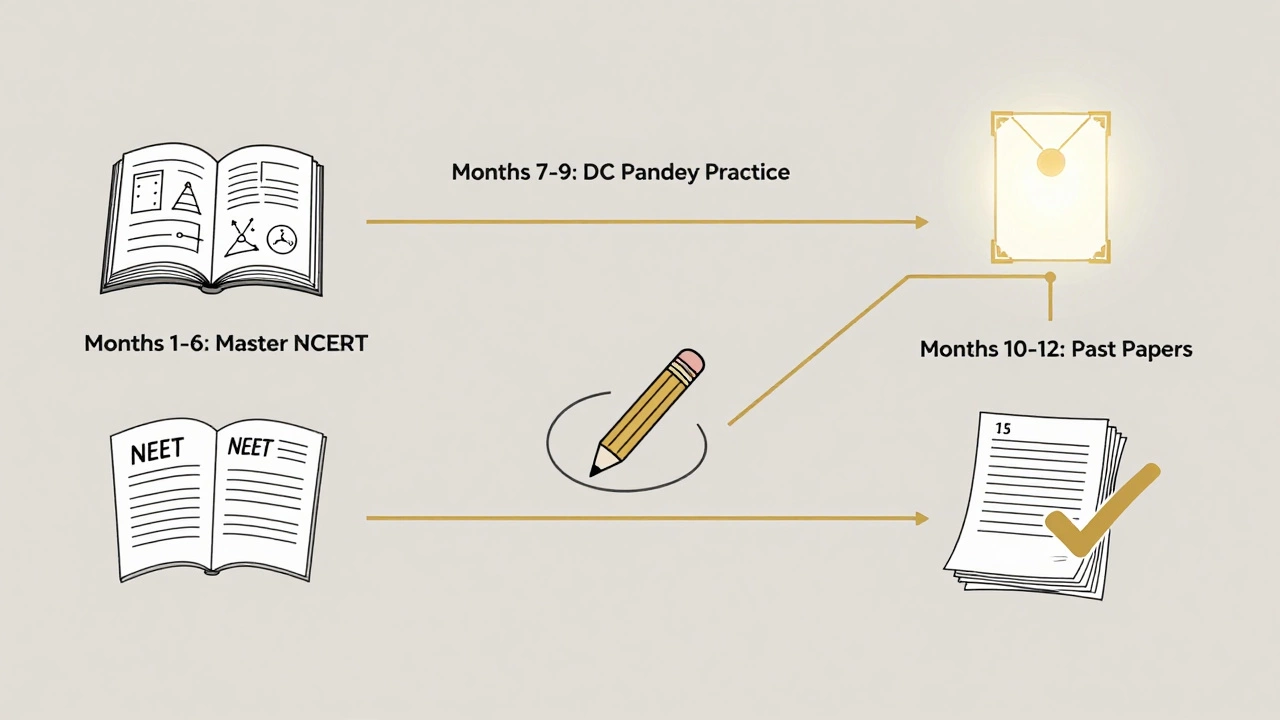
- Months 1-6: Master NCERT. Annotate, redraw diagrams, write down every formula in a notebook.
- Months 7-9: Use DC Pandey for targeted practice. Focus on chapters that carry 5+ marks: Modern Physics, Optics, Electromagnetism.
- Months 10-12: Switch to NEET previous year papers. Time yourself. Analyze every mistake.
- Final Month: Revise NCERT only. No new books. No new problems. Just recall and reinforce.
This method worked for over 12,000 students in 2024 who scored above 650 in NEET. Not because they solved every problem in DC Pandey. But because they knew exactly what the exam wanted - and gave it to them, without wasting a second.
Is DC Pandey enough for NEET physics?
No, DC Pandey is not enough by itself. It’s a strong problem-solving book, but NEET physics is based heavily on NCERT theory, definitions, and diagrams. You need NCERT for the foundation, DC Pandey for practice, and previous year papers to understand the exam pattern.
Should I use HC Verma instead of DC Pandey for NEET?
Not recommended. HC Verma is excellent for deep conceptual understanding and is ideal for JEE aspirants. But for NEET, its problems are often too complex and time-consuming. DC Pandey offers a better balance of difficulty and relevance for NEET’s pattern.
How many questions should I solve from DC Pandey for NEET?
Solve 15-20 problems per chapter, focusing on Level 1 and Level 2 questions. Skip advanced-level problems unless you’re aiming for 170+ in physics. Quality matters more than quantity - understand why you got a question wrong, not just how to solve it.
Is NCERT enough for NEET physics?
NCERT is necessary but not sufficient. It gives you the theory and 80% of the content, but you need practice to build speed and accuracy. Combine NCERT with DC Pandey for problems and past papers for pattern recognition.
What’s the best book for last-minute NEET physics revision?
Arihant’s NEET Physics Previous Years’ Papers is the best. It shows you exactly what’s been asked, how often, and in what format. Revise NCERT and solve 5-7 past papers in the final month. That’s more effective than opening a new book.