
JEE Subject Improvement Calculator
Calculate how much your JEE scores could improve based on your current performance and study hours. Get personalized recommendations for maximum score gains.
Your Current Scores
Key Recommendations
Projected Score Improvements
When you're preparing for IIT JEE, one question keeps coming up: Which subject is best? It’s not about picking the easiest or the hardest. It’s about finding the subject that gives you the most return on your time and effort. The truth? There’s no single answer that works for everyone. But there are clear patterns based on how the exam is structured, what students actually score in, and what top rankers do differently.
Physics: The Foundation, Not the Star
Physics is where most students get stuck. It’s not because it’s impossible - it’s because it’s misunderstood. You can’t just memorize formulas and hope to crack JEE Advanced. You need to visualize forces, understand energy flow, and connect concepts across chapters. A student who masters Newton’s laws, rotational motion, and electromagnetism doesn’t just solve problems - they predict them.
In JEE Advanced, 35-40% of the physics paper comes from mechanics and electricity. That’s not a coincidence. These are the backbone topics. If you can solve a problem involving a rolling disc with friction and an electric field, you’re already ahead of 70% of the crowd. The trick? Practice with real past papers. Don’t just solve - analyze. Why did this question appear? What concept was hidden in plain sight?
Many students think physics is the hardest. But that’s often because they skip the fundamentals. Start with kinematics. Master free-body diagrams. Then move to thermodynamics. By the time you reach modern physics, you’ll see how everything connects. Physics isn’t about knowing more - it’s about thinking deeper.
Chemistry: The Memory Game With Logic
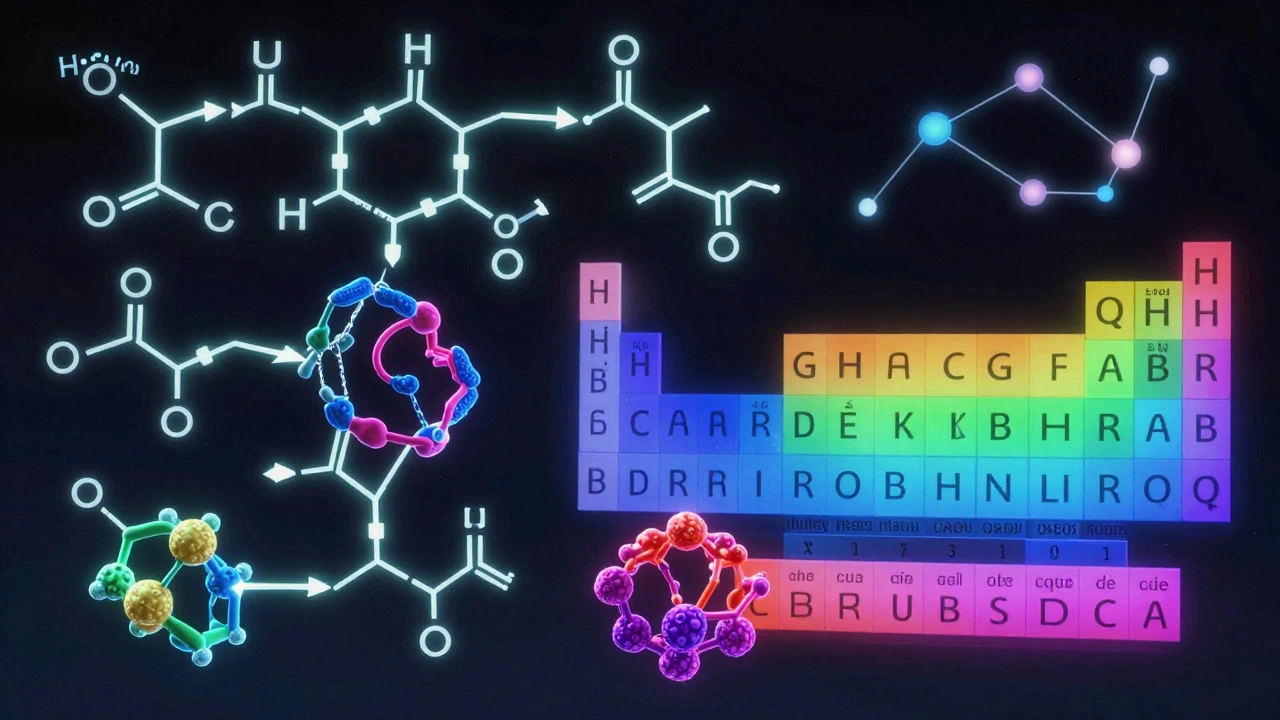
Chemistry is the subject where you can gain the most points in the least time. Organic chemistry? It’s a chain reaction of reactions. Inorganic? It’s patterns. Physical chemistry? It’s math with meaning.
Organic chemistry makes up nearly 40% of the chemistry section. And guess what? 80% of those questions come from just five reaction types: substitution, elimination, addition, rearrangement, and oxidation-reduction. If you learn the mechanisms behind these - not just the products - you’ll start seeing patterns in every question. For example, if a question mentions a Grignard reagent and a carbonyl, you already know the product before reading the options.
Inorganic chemistry is often ignored. Big mistake. Topics like coordination compounds, periodic trends, and qualitative analysis are low-effort, high-reward. The JEE loves asking about crystal field splitting or the color of transition metal complexes. These are memorization-heavy, but once you know them, you get them right every time.
Physical chemistry is where logic wins. Thermodynamics, equilibrium, electrochemistry - these are built on formulas, yes, but they’re also built on logic. If you understand why ΔG = ΔH - TΔS matters, you can predict spontaneity without plugging in numbers. That’s the edge.
Mathematics: The Score Multiplier
Mathematics is where the top 1% pull ahead. Why? Because it’s the only subject where you can score 100% if you’re prepared. No guesswork. No ambiguity. Just solve it right or get zero.
Calculus is king. Limits, derivatives, integrals - they show up in every paper. In JEE Advanced 2024, 28% of the math paper was calculus. And 70% of those questions were application-based. Not just “find the derivative” - but “use this derivative to find the maximum area of a rectangle under a curve.” That’s the difference between average and elite.
Coordinate geometry is another powerhouse. Straight lines, circles, parabolas - they’re not just shapes. They’re tools. If you can write the equation of a tangent to a parabola from memory, you’ll solve three questions in under a minute. Practice until you can sketch a conic section from its equation without thinking.
Probability and vectors? They’re easier than they look. In JEE, probability questions are rarely about complex formulas. They’re about counting. How many ways can you arrange letters? How many outcomes satisfy the condition? Master combinatorics, and you’ll crush probability.
The secret? Speed + accuracy. Practice timed tests. Solve 15 math problems in 25 minutes. Not 20. Not 30. 25. That’s the rhythm top scorers live by.
What Top Rankers Actually Do
Let’s cut through the noise. What do the top 100 IIT JEE rankers have in common? They don’t spend 12 hours a day studying. They don’t use 10 different books. They focus on three things:
- They master the core 30% of each subject that gives 70% of the marks.
- They solve past JEE Advanced papers - not just once, but until they can explain every step.
- They test themselves under real exam conditions - no breaks, no phone, no help.
One 2025 topper shared: “I didn’t study chemistry from a textbook. I studied from my own handwritten notes. I wrote down every question I got wrong, why I got it wrong, and how to fix it. That notebook became my Bible.”
It’s not about which subject is best. It’s about which subject you can turn into a strength. For some, that’s math. For others, it’s chemistry. For a few, it’s physics. But the ones who win? They don’t pick one. They build balance.
Don’t Chase the ‘Best’ Subject - Chase Consistency
The myth of the “best subject” is dangerous. It makes you neglect weak areas. If you think chemistry is easy, you’ll skip physics. If you think math is your thing, you’ll ignore organic reactions. That’s how you lose.
Here’s the real strategy: Use your strongest subject to build confidence, then plug the gaps. If you’re great at math, use it to stay motivated. But spend 40% of your time on chemistry and physics - the ones that trip up most students.
Track your mock test scores. Look for patterns. Are you scoring 90% in math but only 50% in physics? That’s your target. Not “which subject is best.” But “where do I need to improve?”
There’s no magic subject. But there is a magic habit: consistent, targeted practice.
Final Reality Check
Let’s look at real data from JEE Advanced 2024:
- Average score in Physics: 38%
- Average score in Chemistry: 47%
- Average score in Mathematics: 52%
Mathematics had the highest average score - but only because it’s the most predictable. Chemistry had the highest score variance - meaning it’s the easiest to improve in. Physics had the lowest average - but also the highest ceiling for top scorers.
So if you’re average? Start with chemistry. It’s the fastest way to jump 15-20 marks.
If you’re already strong? Push physics. That’s where you’ll separate yourself from the rest.
And if you’re aiming for the top 100? You need excellence in all three. No shortcuts. No favorites. Just discipline.
Is physics the hardest subject in JEE?
Physics is often perceived as the hardest because it requires deep conceptual understanding and problem-solving skills. But difficulty is subjective. For many students, organic chemistry or complex calculus problems are harder. The key isn’t avoiding hard topics - it’s mastering the core 30% that appear most frequently.
Which subject gives the most marks in JEE Advanced?
Mathematics typically has the highest average scores because it’s precise and predictable. However, chemistry often offers the fastest improvement - especially in inorganic and organic sections. Focusing on high-yield topics in each subject gives you the most marks per hour studied.
Can I skip physics and still get into IIT?
No. All three subjects - physics, chemistry, and mathematics - are mandatory for JEE Advanced. Even if you score perfectly in math and chemistry, a low physics score will drag your overall rank down. IITs don’t allow subject exemptions. You need balanced preparation.
Should I focus more on chemistry if I’m weak in math?
Yes - but not as a replacement. Chemistry is the most improvable subject. You can gain 15-20 marks in 4-6 weeks by mastering reaction mechanisms and periodic trends. Use those gains to build confidence while you slowly strengthen your math fundamentals. Don’t abandon math - just prioritize chemistry to stabilize your score.
How many hours should I spend on each subject daily?
There’s no fixed rule, but top performers typically divide time based on weakness. A common split is: 40% on weakest subject, 30% on strongest, and 30% on the remaining. For example, if math is your strength, spend 40% on physics, 30% on math, and 30% on chemistry. Adjust weekly based on mock test results.