Online Learning Platform Finder
Answer three simple questions to find the perfect platform for your learning goals.
Your Top Recommendation:
You want to learn something new. Maybe it’s coding, maybe it’s digital marketing, or maybe you just need a certification to get that promotion. You type "who is the best for online classes" into your browser, and suddenly you’re drowning in options. Coursera, Udemy, LinkedIn Learning, Khan Academy-they all claim to be the best. But here is the hard truth: there is no single "best" platform for everyone. The right choice depends entirely on what you are trying to achieve.
If you need a university-grade certificate, one platform wins. If you want to pick up a practical skill this weekend for under $20, another one takes the crown. Choosing the wrong platform wastes money and time. Let’s cut through the noise and figure out which platform actually fits your specific goal.
Key Takeaways
- Coursera and edX are best for academic credentials and university-backed certificates.
- Udemy is the top choice for affordable, specific technical skills like Python or Photoshop.
- LinkedIn Learning works best if you already have a Premium subscription and want career-focused soft skills.
- Skillshare dominates creative fields like design, illustration, and video editing.
- Khan Academy remains the gold standard for free K-12 education and foundational math/science.
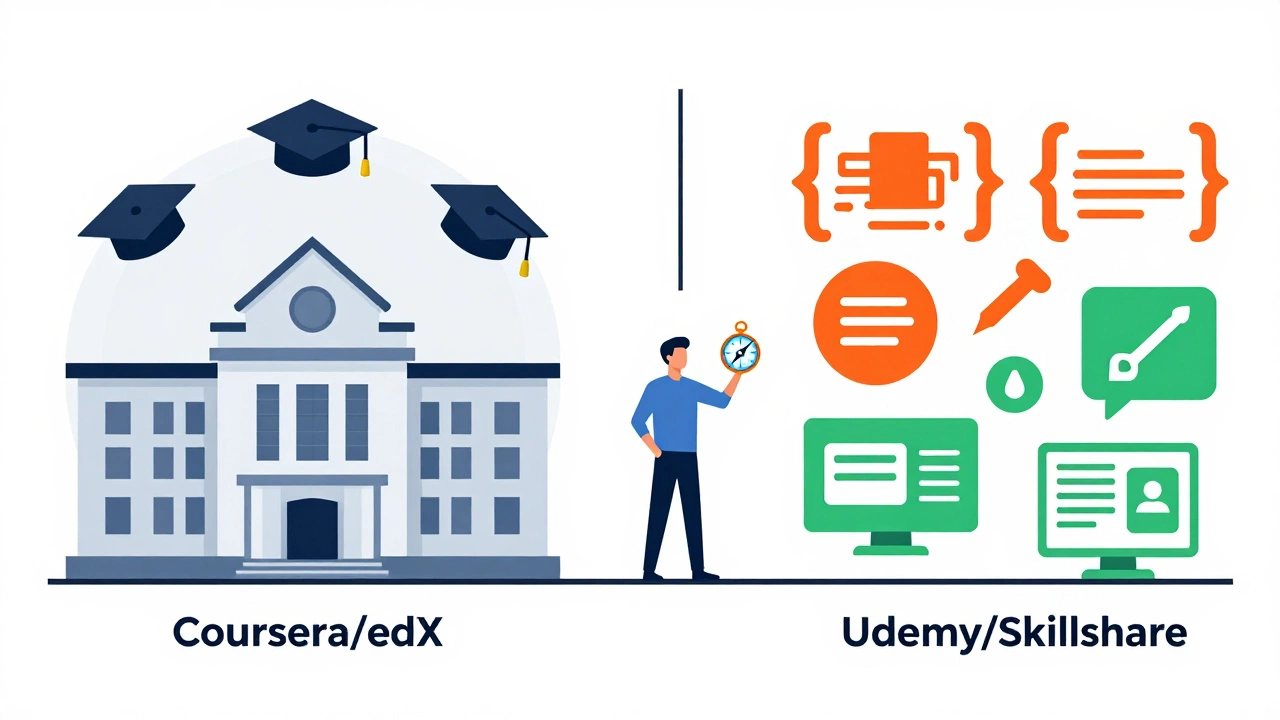
The Credential Seekers: Coursera and edX
If your goal is to boost your resume with recognized credentials, you need platforms that partner with universities. This is where Coursera is an online education provider founded by Stanford professors Andrew Ng and Daphne Koller that offers courses from top universities and companies. Launched in 2012, Coursera has become the go-to for professional certificates. When you finish a course here, you often get a shareable certificate from institutions like Yale, Imperial College London, or Google.
Coursera operates on a subscription model. You can audit many courses for free, but if you want graded assignments and the certificate, you pay a monthly fee (usually around $39-$79). They also offer "Specializations," which are series of courses leading to a final project. For example, their IBM Data Science Professional Certificate is widely recognized in entry-level tech jobs.
edX is a non-profit online learning organization founded by Harvard University and MIT that provides massive open online courses (MOOCs). Like Coursera, edX partners with elite universities. However, edX leans slightly more toward academic rigor. Their "MicroMasters" programs are graduate-level coursework that can sometimes count toward a full master’s degree at participating universities. If you are serious about academia or need a deep dive into subjects like Computer Science or Public Health, edX is often the better fit than Coursera.
Both platforms require a significant time commitment. These aren’t quick tutorials; they are structured courses with weekly deadlines. If you treat them like casual viewing, you will drop out. But if you stick with it, the credential value is high.
The Skill Builders: Udemy
Now, let’s talk about Udemy is a global marketplace for creating and selling online courses where anyone can publish content on any topic. Udemy is not about university prestige. It is about practical, hands-on skills. Want to learn how to use Excel macros? Want to build a website with React? Want to understand cryptocurrency trading? Udemy has a course for that, likely taught by an industry practitioner rather than a professor.
The pricing model here is different. Instead of subscriptions, you buy individual courses. Prices fluctuate wildly due to frequent sales. A course might list for $199, but you will almost always find it for $12.99 during a sale. Never pay full price on Udemy. Wait for a sale, or use a coupon code.
The downside? Quality varies. Anyone can upload a course. Some instructors are brilliant; others are poorly organized. You have to do your homework. Check the ratings, read the recent reviews, and preview the first lecture before buying. Look for courses with over 1,000 students and a rating above 4.5 stars. This filters out the low-effort content.
Udemy is perfect for self-paced learning. There are no deadlines. You can binge-watch a course over a weekend or trickle it in over six months. It is the most flexible option for busy professionals who need a specific tool mastered quickly.
The Career Climbers: LinkedIn Learning
If you are already paying for LinkedIn Premium, you probably already have access to LinkedIn Learning is an online learning service owned by LinkedIn that offers video courses on business, technology, and creative skills. Formerly known as Lynda.com, this platform integrates directly with your professional profile. When you complete a course, you can add the certificate to your LinkedIn endorsements automatically.
The content here is polished and corporate-friendly. It focuses heavily on soft skills: leadership, communication, management, and office productivity tools. While it does have technical courses (like SQL or Project Management), they are often less deep than what you’d find on Udemy or Coursera.
The real value of LinkedIn Learning is the convenience and the networking aspect. It signals to recruiters that you are actively upskilling. If your goal is to improve your managerial abilities or stay current with corporate trends, this is the lowest-friction option. Just remember: the certificate carries less weight outside of the LinkedIn ecosystem compared to a university-backed credential.
The Creatives: Skillshare
For designers, illustrators, writers, and video editors, Skillshare is a community-based online learning platform focused on creative and entrepreneurial skills. is the place to be. Unlike the other platforms, Skillshare feels less like a classroom and more like a workshop. The videos are shorter, more energetic, and often feature working creatives sharing their personal workflows.
Skillshare uses a subscription model. You pay a monthly or annual fee for unlimited access. This is great if you are a voracious learner who wants to try watercolor painting, logo design, and copywriting all in one month. The "Project-Based" approach means every class ends with a tangible output you can share in your portfolio.
However, don’t expect formal certification. Skillshare doesn’t issue diplomas. It issues proof of completion, which looks nice on a portfolio site but won’t impress a traditional HR department. It is best for freelancers and hobbyists who care more about the skill itself than the paper proving they learned it.
The Foundation Builders: Khan Academy
We cannot discuss online classes without mentioning Khan Academy is a non-profit educational organization created by Sal Khan that offers free tutorials in mathematics, science, computing, history, and more. It is completely free. No ads, no hidden fees. If you need to brush up on algebra, biology, or basic economics, Khan Academy is unmatched.
It is primarily aimed at K-12 students, but adults use it too. Many engineers and doctors use Khan Academy to refresh their foundational knowledge before tackling advanced topics elsewhere. The interface is simple, the explanations are clear, and the practice exercises help reinforce learning.
The limitation is scope. Khan Academy does not cover niche professional skills like "Advanced SEO Strategies" or "iOS App Development." It covers the universal basics. Use it to fill gaps in your fundamental understanding, then move to specialized platforms for career-specific training.
Comparison Table: Which Platform Fits You?
| Platform | Best For | Cost Model | Certificate Value | Pacing |
|---|---|---|---|---|
| Coursera | University Credentials & Career Switching | Subscription ($39-$79/mo) | High (Employer Recognized) | Structured (Weekly Deadlines) |
| edX | Academic Rigor & MicroMasters | Per Course or Subscription | High (Academic Focus) | Structured |
| Udemy | Specific Technical Skills | One-time Purchase ($10-$20 on sale) | Low (Skill Proof Only) | Self-Paced (No Deadlines) |
| LinkedIn Learning | Soft Skills & Corporate Training | Subscription (Included in Premium) | Medium (Profile Boost) | Self-Paced |
| Skillshare | Creative Arts & Design | Subscription (~$15/mo) | Low (Portfolio Focus) | Self-Paced |
| Khan Academy | Foundational Math/Science | Free | N/A | Self-Paced |
How to Choose: A Decision Checklist
Still unsure? Ask yourself these three questions:
- Do I need a certificate for my resume? If yes, look at Coursera or edX. If no, skip to the next question.
- Is my goal creative or technical? If creative (design, writing, art), choose Skillshare. If technical (coding, data analysis, software), choose Udemy for speed or Coursera for depth.
- What is my budget? If zero, start with Khan Academy or free audits on Coursera. If low ($20), wait for a Udemy sale. If higher ($50+/mo), consider a Coursera Plus or LinkedIn Learning subscription for variety.
Common Pitfalls to Avoid
Even with the best platform, you can fail. Here is why people quit online courses:
- Buying too many courses: Hoarding courses gives you a false sense of accomplishment. Buy one, finish it, then buy another. Completion beats collection.
- Ignoring the syllabus: On structured platforms like Coursera, skipping weeks leads to confusion. Stick to the schedule, even if it’s just two hours a week.
- Passive watching: Watching a tutorial is not learning. Pause the video. Type the code. Draw the sketch. Take notes. Active participation is the only way to retain information.
Final Thoughts on Finding Your Fit
There is no magic bullet. The "best" platform is the one you will actually use. If you love structure and accountability, Coursera’s deadlines will push you forward. If you hate pressure and prefer to learn in bursts, Udemy’s flexibility will keep you engaged. Experiment. Try a free course on one platform, then a cheap one on another. Your learning style is unique, and your platform should match it.
Is Coursera better than Udemy?
It depends on your goal. Coursera is better if you need a recognized certificate from a university or company for your resume. Udemy is better if you want to learn a specific, practical skill quickly and cheaply without needing formal accreditation.
Are online certificates worth it in 2026?
Yes, but with caveats. Certificates from major providers like Coursera, edX, or industry leaders (Google, Microsoft) carry weight, especially for entry-level roles or career switches. However, employers value demonstrable skills and portfolios more than certificates alone. Use certificates to get the interview, and skills to get the job.
Can I really learn to code for free?
You can learn the basics for free using platforms like Khan Academy, freeCodeCamp, or auditing courses on Coursera and edX. However, structured feedback, mentorship, and certificates usually cost money. Free resources are excellent for starting, but dedicated bootcamps or paid courses may accelerate your path to employment.
Which platform is best for beginners?
For absolute beginners in general subjects, Khan Academy is the most user-friendly and free. For professional skills, Coursera offers "Introductory" specializations that guide you step-by-step. Udemy can be overwhelming for beginners due to the lack of quality control, so stick to highly-rated courses with large student counts.
Do employers care about LinkedIn Learning certificates?
They notice them, but they don’t weigh them heavily. LinkedIn Learning certificates show initiative and continuous learning, which is positive. However, they are not equivalent to university degrees or industry-standard certifications (like PMP or AWS Certified). Use them to supplement your profile, not replace core qualifications.
How much should I spend on online courses?
Start small. Spend under $20 on Udemy for specific skills. Budget $39-$79 per month for Coursera or Skillshare if you plan to take multiple courses. Avoid expensive bootcamps unless you have researched their job placement rates thoroughly. Always check if your employer or local library offers free access to these platforms.