Free Course Cost Calculator
Calculate the real cost of a free online course - not just the certificate fee, but time investment and hidden costs too.
Estimated Total Cost
You’ve seen the ads: "Learn Python for free!" "Get a certificate from Harvard-no cost!" "Master digital marketing without spending a dime." It sounds too good to be true. And honestly? It often is.
What "free" actually means in online courses
When a platform says a course is free, they usually mean you can access the video lectures, readings, and maybe even quizzes without paying. But that’s just the surface. The real cost shows up later-in ways you might not expect.
Take Coursera, edX, or FutureLearn. They let you enroll in courses like "Introduction to Psychology" or "Data Science Fundamentals" at $0. But if you want the certificate? That’s where you hit the paywall. Most platforms charge $50 to $100 for a verified certificate. Without it, employers don’t recognize your completion. You spent hours learning, but your effort has no official weight.
And here’s the catch: even if you skip the certificate, you’re still paying. Time is money. If you’re juggling a job, family, or school, every hour spent on a free course is an hour you could’ve used to earn, rest, or build real skills in a paid program with mentorship.
The certificate trap
Certificates aren’t just badges. They’re gatekeepers. In India, over 68% of recruiters say they only consider candidates who have verified credentials from recognized platforms, even for entry-level roles (based on 2025 job market survey by Naukri.com). A free course without a certificate? It’s like having a driver’s license with no photo ID-you know how to drive, but no one will let you rent a car.
Some platforms offer financial aid. Coursera has a waiver system where you can apply for free access to the certificate if you prove financial need. But the process? It’s clunky. You need to write a personal statement, wait days for approval, and even then, it’s not guaranteed. If you’re not in a position to argue your case, you’re locked out.
Hidden fees you won’t see until it’s too late
There’s more than just certificates. Some courses require:
- Textbooks you must buy separately (even if the course says "all materials included").
- Software subscriptions-like MATLAB, Adobe Creative Cloud, or SPSS-that cost $20/month.
- Proctoring fees for final exams, especially in certification tracks.
- Optional add-ons: coaching sessions, peer feedback, or resume reviews-all priced separately.
One learner in Pune enrolled in a "free" Google Data Analytics course. After 8 weeks, they realized they needed to pay $39/month for access to the capstone project simulator. They’d already invested 40 hours. Quitting meant losing everything. Paying meant $312 for a course they thought was free.
Platform lock-in: The subscription squeeze
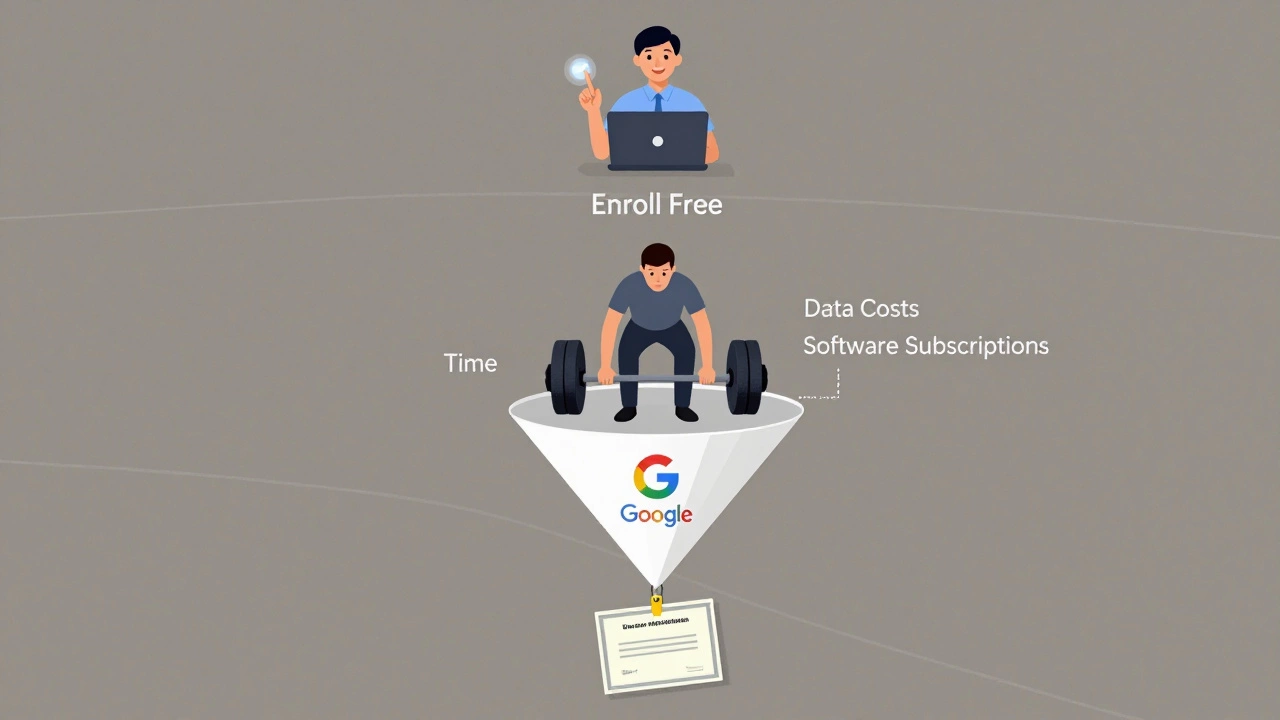
Many "free" courses are gateways to subscriptions. Udemy doesn’t charge upfront-but it pushes you toward "Udemy Pro" at $15/month. edX’s "Audit" track lets you learn for free, but if you want to keep access after the course ends? You’re asked to upgrade. That’s not generosity. It’s a funnel.
Think of it like a gym that lets you use the treadmill for free, but charges you to use the weights, the locker, or even the water fountain. You’re not getting a free education-you’re getting a free taste.
Who really benefits from "free" courses?
The platforms do. They use free courses to collect data: what you click on, how long you watch, where you drop off. That data trains their AI to sell you more courses, subscriptions, or even job ads. Your attention is the product.
Universities benefit too. They get global exposure. Stanford, MIT, and IITs use free courses to build brand trust. But they don’t give you the same support as paying students. No teaching assistants. No office hours. No grading feedback. You’re on your own.
And what about you? If you’re unemployed, underemployed, or looking to switch careers, free courses can help. But only if you’re disciplined, have internet access 24/7, and can afford the hidden costs later. For many in India-especially outside metro cities-the cost of data, electricity, and time makes "free" courses a luxury.

What’s truly free? The alternatives
Not all free learning is a trap. Here are real alternatives:
- Khan Academy: No certificates, no paywalls. Just clear, high-quality lessons in math, science, and economics. Used by over 15 million students in India alone.
- NPTEL (National Programme on Technology Enhanced Learning): Run by IITs and IISc. Free video lectures, assignments, and even proctored exams with certificates-for free. No hidden fees. Just register and learn.
- YouTube channels: Channels like "freeCodeCamp", "MySirG", or "Gaurav Sen" offer full courses in coding, finance, and career skills. No sign-up. No tracking. No upsells.
- Public libraries: Many city libraries in Bangalore, Hyderabad, and Lucknow now offer free access to LinkedIn Learning and Coursera with a library card. No credit card needed.
These options don’t promise certificates. But they deliver real knowledge without the strings attached.
When free courses are worth it
Free courses aren’t useless. They’re valuable if:
- You’re exploring a field before committing to a paid program.
- You need to refresh skills and already have a job.
- You’re using them as supplements-not replacements-for structured learning.
- You’re on a tight budget and can wait to pay later when you’re ready.
But if you’re counting on a free course to land a job, get promoted, or switch careers? You’re setting yourself up for disappointment. Employers don’t care that you watched 12 hours of lectures. They care if you can solve problems, build projects, or show results.
Bottom line: Free isn’t free
Free online courses aren’t scams. But they’re not gifts either. They’re marketing tools. They’re data harvesters. They’re funnels.
If you want real value, ask yourself: What am I getting that I can’t get elsewhere? Is it knowledge? Or just the illusion of progress?
For most people in India, the best path isn’t chasing free certificates. It’s finding free, open resources like NPTEL, using public library access, or joining local study groups. Build skills. Build projects. Show your work. That’s what employers actually notice.
True learning doesn’t come with a price tag. But it does come with effort. And that? That’s the only cost that really matters.
Are free online courses really free if I don’t want a certificate?
Yes-if you only want to learn. Platforms like Khan Academy and NPTEL let you access full course content without any payment, even for exams. But if you’re on platforms like Coursera or edX, even audit tracks may limit access to assignments or video downloads after a few weeks. You’ll still be able to watch lectures, but you won’t get feedback, support, or long-term access without paying.
Can I get a free certificate from a free online course?
Sometimes, but rarely. Only a few platforms offer truly free certificates. NPTEL (India’s official government-backed program) gives free certificates after passing proctored exams. Coursera and edX offer financial aid, but you must apply and prove need. Most "free" certificates require payment. Don’t believe ads that say "free certificate"-they’re usually misleading.
Why do companies like Google and IBM offer free courses?
They’re building talent pipelines. Google’s free IT Support Certificate, for example, is designed to funnel learners into their job board. IBM does the same with AI and cloud courses. You get free training. They get pre-trained candidates. It’s not charity-it’s recruitment. The certificate itself has value only if you apply through their partner hiring network.
Is NPTEL better than Coursera for free learning in India?
For Indian learners, NPTEL is often better. It’s backed by IITs and IISc, uses local language support, and offers free proctored exams with government-recognized certificates. Coursera’s content is high-quality, but it’s designed for global, English-speaking audiences. NPTEL’s exams are accepted by many Indian universities and public sector jobs. Plus, no credit card is needed.
What’s the best way to learn online without paying anything?
Start with NPTEL for technical subjects, Khan Academy for fundamentals, and YouTube channels like freeCodeCamp or MySirG for coding. Use your local library’s digital access to platforms like LinkedIn Learning. Join free study groups on Discord or Telegram. Build real projects-upload them to GitHub. That’s how you prove skills without a certificate.