
eLearning Phase Checklist
Are you creating an eLearning course? Make sure you don't skip any phases of the ADDIE model. This checklist will help you verify you've covered all critical areas for an effective learning experience.
Check Your Phases
Select each phase to check off your progress and see important reminders for that stage.
Analysis: Know Who You're Teaching
Phase 1 of 5
This is where most courses fail. Start with learners, not content. Ask: Who is this for? What do they already know? What's stopping them from getting better?
Design: Map the Learning Journey
Phase 2 of 5
This is your blueprint. Focus on structure: What sequence makes sense? Where will learners get stuck? How will you know they've understood?
Development: Build It Right, Not Just Fast
Phase 3 of 5
This is where content gets made. Ensure alignment with your design: If you need practice, provide interactive exercises. If you need peer feedback, build that feature.
Implementation: Launch and Support
Phase 4 of 5
Launching isn't hitting 'publish.' It's about onboarding users and providing support. Many courses fail because learners don't know how to use the platform.
Evaluation: Measure What Matters
Phase 5 of 5
This phase measures what matters: Did learners change behavior? Did it save time or money? Satisfaction scores are useless.
Ever finished an online course and felt like you learned nothing, even though you watched every video? That’s not your fault. Most eLearning courses skip the real work-planning, design, and follow-up. The magic of effective eLearning doesn’t happen when you hit play. It happens in five clear phases, done right, before, during, and after the content even loads.
Analysis: Know Who You’re Teaching and What They Need
This is where most online courses fail. They start with content instead of learners. The analysis phase asks: Who is this for? What do they already know? What’s stopping them from getting better?
Imagine you’re building a course for bank clerks in India who need to learn new KYC rules. You don’t just dump a 40-minute video on compliance. You find out they’re already using the old system daily. They’re overwhelmed by paperwork. Their biggest pain? Time. They can’t sit through long lectures. So you design short, mobile-friendly microlearning clips-under 5 minutes each-paired with quick checklists they can use at their desk.
This phase includes surveys, interviews, and even shadowing learners in their real environment. Without this, you’re guessing. And guessing leads to courses that gather dust.
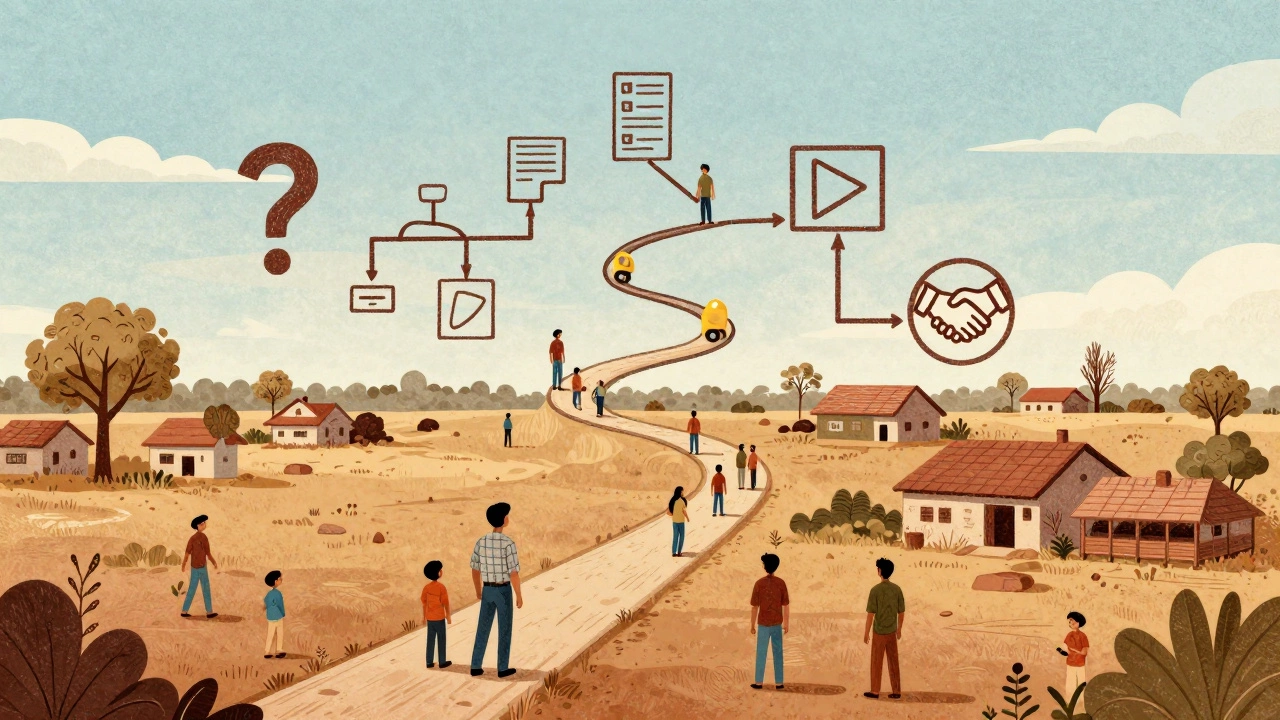
Design: Map the Learning Journey
Design is the blueprint. It’s not about colors or buttons. It’s about structure. What sequence makes sense? Where do learners get stuck? How will you know they’ve understood?
A good design phase answers these questions:
- What’s the single goal of this course? (Example: "Complete KYC form correctly in under 3 minutes.")
- What steps must learners take to reach that goal?
- Where will you test their understanding? (Not just a quiz at the end-checkpoints after each key concept.)
- What kind of feedback will they get? (Real-time hints? Peer review? Automated corrections?)
Many platforms skip this. They take a PowerPoint, slap it into a video tool, and call it a course. That’s not design. That’s repackaging. Good design turns confusion into clarity. It turns passive watching into active doing.
Development: Build It Right, Not Just Fast
This is where content gets made. Videos, quizzes, interactive simulations, downloadable templates, discussion prompts. But development isn’t just about recording. It’s about alignment.
If your design said learners need to practice filling out a form, your development phase delivers an interactive form they can drag and drop fields into-not a static image. If your design said learners need peer feedback, you build a simple forum or group chat feature inside the platform.
Too many eLearning teams rush this step. They use cheap templates. They reuse old videos. They forget mobile users. In India, over 70% of learners access courses on smartphones. If your course doesn’t work on a 5-inch screen with slow data, it’s broken.
Development means testing on real devices. It means checking load times. It means making sure text is readable without zooming. It means ensuring videos auto-play without sound and still make sense.
Implementation: Launch and Support
Launching a course isn’t hitting "publish." It’s handing out keys to a house you built-and then standing by to help people find the light switch.
Implementation includes:
- Onboarding users-how do they log in? Where do they start?
- Training facilitators or supervisors who support learners
- Setting up reminders and nudges (email, SMS, in-app alerts)
- Providing tech support channels
At a government training center in Hyderabad, they saw 60% dropout rates in their first eLearning rollout. Why? Learners didn’t know how to access the platform. No one told them their login was their employee ID + a default password. They fixed it by sending a one-page guide with a photo of the login screen. Dropouts dropped to 18%.
Implementation is where good intentions go to die-or thrive. If you don’t support learners when they hit their first wall, they’ll leave. No matter how great your content is.

Evaluation: Measure What Matters
Did they learn? Did they change behavior? Did it save time or money? These are the only questions that matter.
Most courses only measure satisfaction: "How was the course?" (5 stars, great job!). That’s useless. You want to know:
- Did learners complete the task correctly after the course?
- Did their error rate drop on the job?
- Did they use the new skill within 7 days?
At a call center in Bangalore, agents took a course on handling complaints. Two weeks later, managers checked call recordings. Complaint resolution time dropped by 22%. Customer satisfaction scores rose by 17%. That’s evaluation.
Use simple tools: pre- and post-assessments, task completion logs, manager feedback, even tracking how often learners revisit resources. If no one goes back to the module after finishing, it didn’t stick.
This phase isn’t just for reporting. It’s for fixing. If 40% of learners failed the final quiz on one topic, go back to the design. The problem wasn’t the learner. It was the course.
Why This Five-Phase Model Works
This isn’t just theory. It’s the ADDIE model-used by corporate trainers, universities, and government agencies worldwide. It’s not flashy. It’s not trendy. But it works because it’s grounded in how people actually learn.
Most eLearning platforms sell you tools. They don’t teach you how to use them right. The platform is just a container. The real value is in the process behind it.
When you follow these five phases, you stop creating courses and start creating change. You stop hoping learners will "get it" and start designing for them to succeed.
It’s not about having the fanciest LMS. It’s about asking the right questions before you build anything.
Are the five phases of eLearning the same as the ADDIE model?
Yes, the five phases-Analysis, Design, Development, Implementation, and Evaluation-are the core of the ADDIE model, a standard framework in instructional design since the 1970s. It’s not just for eLearning; it’s used in corporate training, military education, and university courses. The "e" in eLearning doesn’t change the learning process-it just changes the delivery method.
Can I skip a phase if I’m on a tight deadline?
You can skip a phase, but you’ll pay for it later. Skipping Analysis means you’re teaching the wrong thing. Skipping Design means your course feels random. Skipping Evaluation means you’ll never know if it worked. If you’re rushed, shorten each phase-but don’t remove it. Even a 2-day analysis with 5 learner interviews beats a 2-week one with no input.
Do I need special software to follow these phases?
No. You can do all five phases with free or basic tools. Use Google Forms for Analysis, Canva for Design, Loom or CapCut for Development, WhatsApp or email for Implementation, and simple spreadsheets for Evaluation. The tool doesn’t make the course work. The process does.
Is this only for corporate training?
No. This works for any learning situation. A high school teacher creating a YouTube-based biology module? Use the five phases. A parent teaching their child math through apps? Use the five phases. A community center offering digital literacy classes? Use the five phases. It’s not about who’s learning-it’s about how they learn.
How long should each phase take?
There’s no fixed timeline. A 1-hour microcourse might take 3 weeks total-1 week per phase. A 10-week university module might take 6 months. The rule is: spend more time on Analysis and Evaluation. That’s where most mistakes happen. Development should be efficient, not rushed. A well-analyzed course can be built quickly. A poorly analyzed one takes forever to fix.