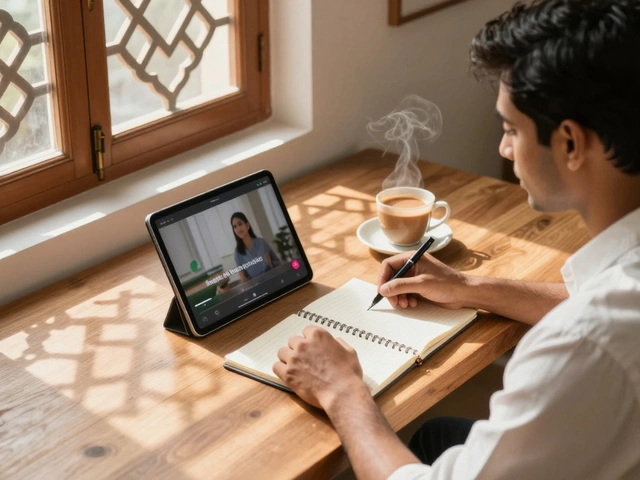
There’s no single best method to teach English. That’s the truth most textbooks won’t tell you. If you’ve ever sat through a classroom where grammar rules were drilled like math formulas, or watched students memorize dialogues only to freeze when someone actually spoke to them, you know something’s off. Teaching English isn’t about following a script-it’s about creating conditions where people actually start using the language, not just studying it.
Why Traditional Methods Fail Most Learners
For decades, the go-to method was grammar-translation. Students learned verb conjugations in isolation, memorized vocabulary lists, and took written tests. It worked for a small group-people who already liked analyzing language like puzzles. But for the vast majority? It created learners who could write an essay about the past perfect tense but couldn’t order coffee without panic.
A 2023 study by the British Council tracked 2,000 adult learners across India, Brazil, and Indonesia. Those taught with traditional methods showed 78% improvement in grammar tests after six months. But only 22% could hold a five-minute conversation without hesitation. The gap wasn’t about intelligence. It was about exposure. They weren’t learning to speak-they were learning to pass exams.
Real fluency doesn’t come from memorizing rules. It comes from repeated, low-pressure use. Think of how kids learn their first language: they hear it, mimic it, make mistakes, and get corrected gently-over and over. Adults need the same thing, just with more structure.
The Communicative Approach: What Actually Works
The most effective method today is called the communicative approach. It flips the script. Instead of starting with grammar, it starts with purpose. What do you need English for? Job interviews? Travel? Chatting with coworkers? The lesson is built around that real need.
In a communicative classroom, you don’t learn “present continuous tense” as a rule. You learn how to say, “I’m meeting my client at 3,” because you need to schedule a call. The grammar shows up naturally-when it’s useful, not abstract.
Here’s how it works in practice:
- Start with a real-life scenario: booking a hotel, explaining a problem at work, giving directions.
- Let learners try to express it in their own words-even if it’s broken English.
- Teacher listens, notes errors, and offers corrections only after the message is understood.
- Repeat the scenario with improved language, then switch to a new one.
This method works because it builds confidence faster. Learners aren’t waiting to be “ready.” They’re using English from day one, even if it’s imperfect. Mistakes become part of the process, not failures.
Immersion Isn’t Just About Travel
People think immersion means moving to London or New York. But you don’t need a passport. You need consistent exposure.
One of the most powerful tools for teaching English is audio and video content that’s just slightly above the learner’s level. Not too hard, not too easy. Think of it like training for a race-you don’t start with a marathon. You start with a 5K and build up.
For beginners: short YouTube videos with subtitles (like “Learn English with Emma” or “English Addict with Mr Steve”).
For intermediates: podcasts like “The Daily” or “6-Minute English” with transcripts.
For advanced learners: TV shows without subtitles, TED Talks, or business news clips.
The key? Active listening. Not just playing it in the background. Pause. Repeat. Shadow the speaker. Say it out loud. Record yourself. Compare. This isn’t passive learning-it’s muscle training for your mouth and ears.
Speaking Practice Without a Teacher
Not everyone can afford daily classes. But speaking practice doesn’t require a teacher. It requires a routine.
Here’s a simple daily habit that changes everything:
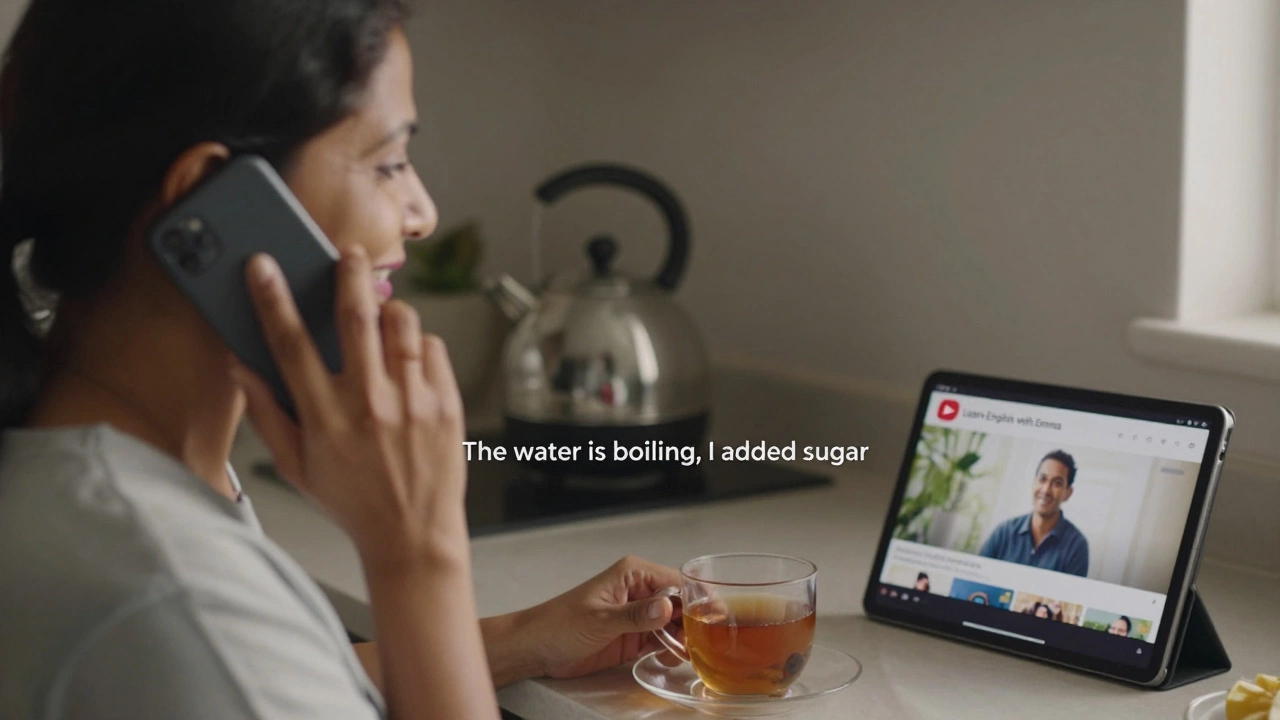
- 5 minutes: Talk to yourself in English. Describe what you’re doing. “I’m making tea. The water is boiling. I added sugar.”
- 10 minutes: Watch a 3-minute clip from a show you like. Pause every sentence. Repeat it out loud.
- 5 minutes: Write down three new phrases you heard. Say them three times.
Do this every day for 30 days, and you’ll notice a shift. Your brain stops translating from your native language. You start thinking in English.
Apps like ELSA Speak or Speechling give instant feedback on pronunciation. They’re not magic, but they’re better than silence. If you’re stuck with no one to talk to, talk to an app. It’s better than not talking at all.
Why Group Classes Often Fall Short
Group classes are popular. They’re affordable. But they’re not always effective.
In a class of 12 students, each person might speak for 2 minutes total in a 90-minute lesson. That’s not practice. That’s waiting.
One-on-one lessons are better, but only if the teacher is trained in the communicative method. Many teachers still fall back on grammar drills because that’s what they were taught. Ask your teacher: “Can we focus on real conversations today?” If they say, “We need to finish the textbook first,” find someone else.
Look for teachers who:
- Correct you after you finish speaking, not while you’re mid-sentence.
- Ask open-ended questions: “What did you do last weekend?” not “What’s the past tense of ‘go’?”
- Use real materials: news articles, job ads, emails-not made-up textbook dialogues.
What Doesn’t Work (And Why)
Some methods sound good but don’t deliver.
Memorizing dialogues: “Hello, how are you? I’m fine, thank you.” This teaches robotic responses, not real conversation. People don’t speak like scripts.
Translation-heavy learning: Constantly thinking in Hindi or Bengali and converting to English slows you down. Your brain gets stuck in translation mode.
Only focusing on pronunciation: Clear speech matters, but if you can’t express ideas, no one will understand you-even if your accent is perfect.
Waiting until you’re “ready”: There’s no magic point where you suddenly know enough. You learn by doing, not by waiting.
Putting It All Together: A Simple Plan
If you’re serious about learning to speak English, here’s a realistic weekly plan:
- Monday: Watch a 5-minute video and repeat after it.
- Tuesday: Talk to yourself for 10 minutes about your day.
- Wednesday: Have a 15-minute conversation with a teacher or language partner.
- Thursday: Listen to a podcast and write down 3 new phrases.
- Friday: Watch a scene from a movie without subtitles. Try to guess what’s happening.
- Saturday: Write a short message (text or email) in English to a friend.
- Sunday: Review what you learned. What did you say well? What tripped you up?
That’s 60-90 minutes a week. Not much. But done consistently, it changes everything.
It’s Not About Perfection
The goal isn’t to sound like a native speaker. It’s to be understood. To ask for help. To explain your ideas. To laugh when you mess up and keep going.
One of my students, a nurse from Chennai, started speaking English after her son asked her to help him with his homework. She didn’t care about grammar. She just wanted to understand his science book. After six months of daily practice, she could explain photosynthesis to him in English. That’s success.
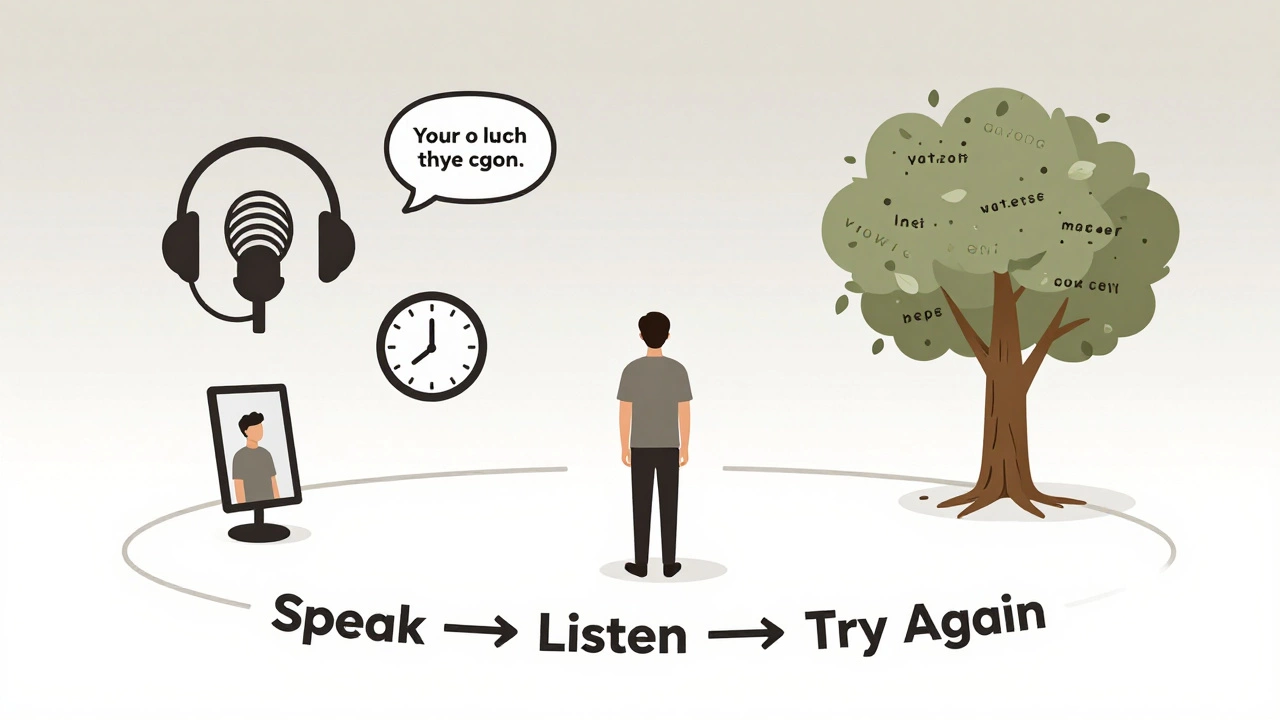
There’s no secret technique. No app that will magically make you fluent. The best method to teach English is simple: talk. Listen. Try again. And don’t stop.
Is there a single best method to teach English?
No, there isn’t one single best method. The most effective approach combines real-life communication, consistent exposure to spoken English, and frequent speaking practice. Methods that focus only on grammar or memorization rarely lead to fluency. The key is using English to do real things, not just studying it.
Can I learn to speak English without a teacher?
Yes, you can. Many people become fluent using self-study tools like podcasts, YouTube channels, pronunciation apps, and speaking to themselves daily. The challenge isn’t access to resources-it’s consistency. Without a teacher, you need to be disciplined about practicing speaking every day, even if it’s just for 10 minutes. Recording yourself and comparing it to native speakers helps a lot.
How long does it take to become fluent in spoken English?
It varies, but most learners see noticeable progress in 3-6 months with daily practice. Fluency-being able to speak smoothly on most topics-usually takes 12-18 months. The speed depends on how much you listen and speak, not how many grammar rules you memorize. Someone who speaks 30 minutes a day will outpace someone who studies 3 hours a week but never talks.
Should I focus on grammar or speaking first?
Focus on speaking first. Learn grammar as you go. Trying to master all the rules before speaking creates mental blocks. You’ll learn past tense when you need to talk about yesterday. You’ll learn conditionals when you want to say, “If I had more time, I’d practice more.” Grammar becomes useful when it helps you say what you actually want to say.
Are online English courses worth it?
Some are, some aren’t. Look for courses that prioritize conversation over worksheets. Avoid ones that promise fluency in 30 days or focus mostly on multiple-choice tests. The best online courses give you real speaking time with a trained teacher who corrects you after you speak-not during. Check reviews from learners who actually improved their speaking, not just their test scores.
What’s the biggest mistake people make when learning to speak English?
Waiting to be perfect before speaking. Most learners hold back because they’re afraid of making mistakes. But every mistake is a learning opportunity. The fastest progress comes from people who speak even when they’re unsure. Fluency isn’t about being correct-it’s about being clear and confident enough to keep going.