
Career Path Finder
Answer these quick questions to find the easiest high-paying course for your personality and strengths in 2026.
- Time to Job Ready:
- Avg. Starting Salary:
- Key Skills:
Note: The "easiest" course is the one you will actually finish. Consistency beats intensity.
You want a paycheck that clears your debts and funds your dreams, but you don't want to spend four years drowning in textbooks or pulling all-nighters until your hair falls out. It’s a common dilemma: we assume high earnings require brutal academic sacrifice. But what if the highest paying skills are actually easier to learn than you think? The truth is, many of today’s most lucrative roles prioritize practical application over theoretical depth. You don’t need a PhD in quantum physics to earn six figures; you often just need to master a specific toolset or process.
This isn't about getting rich quick without effort. It's about efficiency. We’re looking for the sweet spot where low cognitive load meets high market demand. Whether you're a career switcher, a student tired of traditional degrees, or someone looking to upskill on weekends, there are paths that offer serious financial returns without requiring you to become a genius overnight. Let’s break down which courses give you the best bang for your buck in terms of time invested versus money earned.
The Myth of "Easy" vs. "Effortless"
First, let’s clear up a misconception. When people ask for the "easiest" course, they usually mean one with less mathematical complexity or fewer abstract theories. They aren't asking for zero work. If a course claims to teach you a high-paying skill in two days while you sleep, it’s a scam. Real ease comes from logical consistency and immediate feedback loops. For example, learning to code can feel hard because errors are cryptic. Learning digital marketing feels easier because the results (clicks, sales) are visible instantly. That visibility reduces mental friction.
In 2026, the job market rewards adaptability more than rote memorization. Employers care less about whether you can derive a complex equation and more about whether you can solve a business problem using available tools. This shift has democratized access to high salaries. You no longer need to be a top 1% student to land a well-paid role. You just need to be competent in a niche that businesses desperately need filled right now.
Data Analytics: The Gateway Drug to Tech Salaries
If you have any comfort with spreadsheets, you already have half the skills needed for a career in Data Analytics. Unlike software engineering, which requires deep knowledge of algorithms and memory management, data analytics focuses on storytelling with numbers. You use tools like SQL, Excel, and Tableau to answer questions like "Which product sells best in winter?" or "Why did user churn spike last month?"
Why is this considered "easy" relative to other tech jobs? Because the barrier to entry is conceptual, not computational. You don't need to write complex backend systems. You need to clean data, visualize it, and present insights. According to recent industry reports, entry-level data analysts in the US can expect starting salaries between $65,000 and $85,000. With just one year of experience, that number jumps significantly. The learning curve is steep at first-learning SQL syntax takes a weekend-but mastering the analytical mindset happens through practice, not intense study.
Courses here focus on practical projects. You’ll build dashboards, not compile kernels. Platforms like Coursera or Udacity offer specializations that take 3-6 months part-time. The key is portfolio building. Show potential employers three solid case studies where you improved a metric by 10%. That proof of competence outweighs a perfect GPA every time.
UX Design: Empathy Over Engineering
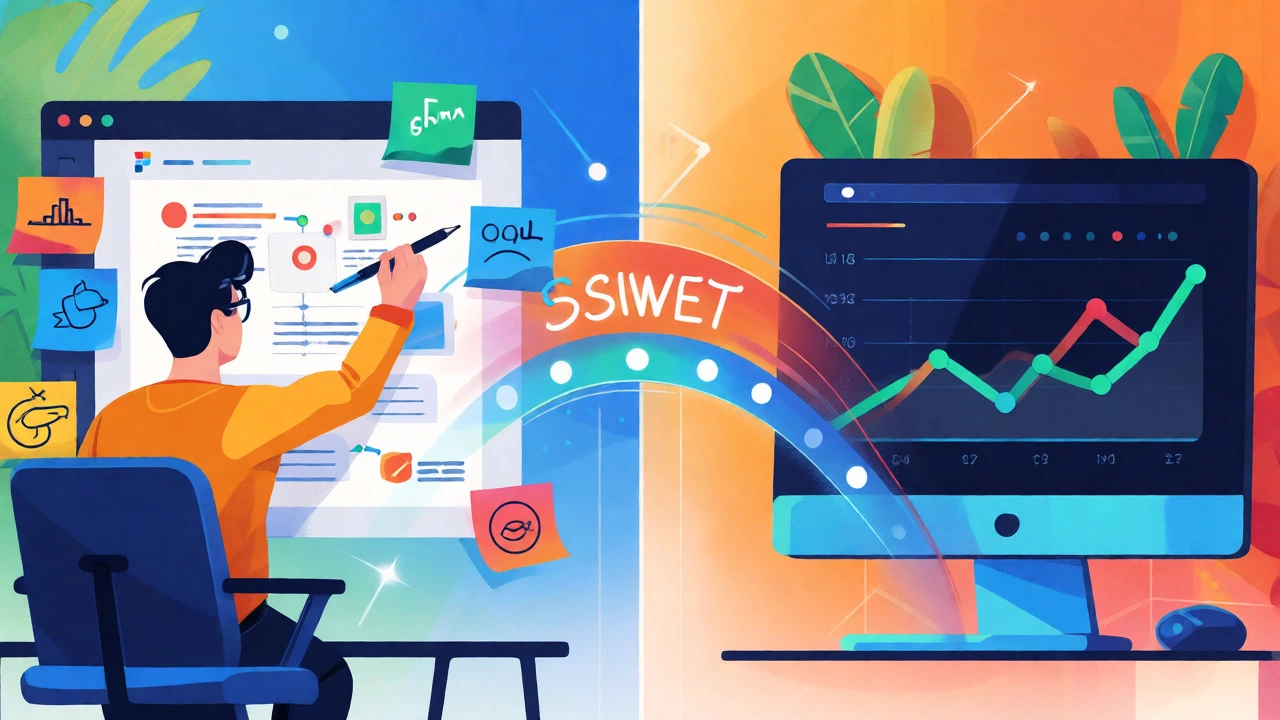
User Experience (UX) Design is another field where creativity trumps calculus. If you’ve ever gotten frustrated trying to use a bad app, you already understand the core problem UX designers solve. The role involves researching user behavior, sketching interfaces, and testing prototypes. It’s highly visual and collaborative, making it feel less isolating than coding.
UX Design is the process of enhancing user satisfaction by improving the usability, accessibility, and pleasure provided in the interaction between the user and the product. It combines psychology, design principles, and basic technical understanding. You don't need to know how to code the front-end, though knowing HTML/CSS helps. Most junior UX designers earn between $70,000 and $90,000 annually. Bootcamps can get you job-ready in 12-24 weeks. The "ease" factor here comes from the iterative nature of the work. You make a prototype, test it, fix it, repeat. There’s rarely one single correct answer, which reduces the pressure of being "wrong."
Tools like Figma have lowered the technical barrier even further. Figma is browser-based, free for starters, and intuitive. You can drag and drop elements to create realistic mockups. Many successful designers come from non-tech backgrounds like journalism, psychology, or graphic arts. Their diverse perspectives often lead to better user solutions than those trained strictly in computer science.
Digital Marketing: Performance Pays the Bills
For those who prefer language and logic over visuals or code, Digital Marketing offers a clear path to high income. Specifically, performance marketing roles like PPC (Pay-Per-Click) specialist or SEO manager command strong salaries. Why? Because these roles directly impact revenue. If you can prove you generated $10,000 in sales for $1,000 in ad spend, you’re valuable.
The learning material is abundant and often free. Google offers its own certifications for Ads and Analytics. These courses are structured, short, and highly practical. You manage real campaigns during your learning phase. Mistakes cost small amounts of money, not project failures. Entry-level salaries hover around $50,000-$65,000, but freelancers and agency managers easily surpass $100,000 once they build a track record.
Unlike pure creative roles, digital marketing is measurable. You see exactly what works. This immediacy makes learning faster. You tweak an ad headline, click update, and watch the metrics change within hours. That feedback loop accelerates skill acquisition dramatically compared to fields where results take months to manifest.
| Course Type | Time to Job Ready | Avg. Starting Salary (US) | Key Skill Focus | Math Intensity |
|---|---|---|---|---|
| Data Analytics | 3-6 Months | $65k - $85k | SQL, Visualization, Logic | Low-Medium |
| UX Design | 3-6 Months | $70k - $90k | Research, Prototyping, Empathy | Very Low |
| Digital Marketing | 2-4 Months | $50k - $65k | Copywriting, Analytics, Strategy | Low |
| Cloud Support | 2-3 Months | $55k - $70k | AWS/Azure Basics, Troubleshooting | Low |

Cloud Support Associate: The IT Foot in the Door
If you’re tech-curious but overwhelmed by programming, consider Cloud Support. Companies run their servers on platforms like AWS, Azure, or Google Cloud. They need people to monitor these systems, handle tickets, and ensure uptime. It’s not about building the cloud; it’s about keeping it running.
Certifications like the AWS Certified Cloud Practitioner are designed for beginners. They cover basic concepts like storage, networking, and security without diving into deep architecture. Study time is roughly 40-60 hours. Once certified, you can apply for support roles. While starting pay might be lower than developer roles ($55k-$70k), the ceiling is high. Many support engineers transition into DevOps or Solutions Architecture later, doubling their salary in five years. The "ease" lies in the procedural nature of the work. Follow the checklist, resolve the ticket, move on.
How to Choose Your Path
Pick based on your natural strengths, not just salary charts. Do you enjoy finding patterns in messy information? Go Data Analytics. Do you care about how things look and feel to users? Choose UX Design. Are you persuasive and good with words? Digital Marketing fits. Do you like fixing problems systematically? Cloud Support is ideal.
- Assess your tolerance for ambiguity: UX and Marketing involve trial and error. Data and Cloud are more rule-based.
- Evaluate your math anxiety: If numbers scare you, avoid heavy statistics-focused data science tracks. Stick to visualization-heavy analytics or marketing.
- Consider your portfolio needs: UX and Data require tangible projects. Marketing can showcase live campaign results. Certifications help validate Cloud skills.
Remember, the "easiest" course is the one you will actually finish. Consistency beats intensity. Spending 30 minutes a day on a relevant certification yields better results than cramming for a week and quitting. In 2026, employers value demonstrated ability over pedigree. Build something, measure it, and show it off. That’s the fastest route to a high salary.
Do I need a degree for these high-salary courses?
No, most tech and marketing companies in 2026 prioritize skills and portfolios over formal degrees. Certifications from recognized providers like Google, AWS, or major universities combined with a strong project portfolio are often sufficient to land interviews.
Which course has the highest earning potential long-term?
Data Analytics and UX Design tend to have higher long-term ceilings because they lead into specialized senior roles like Data Science or Product Management. However, skilled Digital Marketers who specialize in performance can also reach six figures quickly through freelance rates or agency leadership.
Is coding required for Data Analytics?
Basic coding is helpful but not always mandatory. SQL is essential, which is a query language rather than general-purpose programming. Python is increasingly common for automation and advanced analysis, but many entry-level analyst roles rely heavily on Excel and visualization tools like Tableau or Power BI.
How long does it take to get hired after finishing a course?
Typically 3 to 6 months after completing the coursework. This period includes building a portfolio, networking, and applying. Having 2-3 solid case studies ready significantly speeds up the hiring process compared to having only a certificate.
Are online certificates respected by employers?
Yes, especially if they are from reputable institutions or tech giants (Google, Microsoft, IBM). Employers view them as proof of current, relevant knowledge. However, the certificate alone is rarely enough; you must demonstrate application through projects or internships.