Academic Difficulty Analyzer
Configure Your Course Profile
Why Does It Feel Hard?
- Pacing: Too much material in too little time.
- Abstraction: Moving from calculation to proof/logic.
- Stakes: Grading curves and future career implications.
- Support: Large class sizes with limited help.
Difficulty Assessment
Based on your inputs, this course presents a significant challenge due to...
Survival Strategy
You’ve heard the rumors. You’ve seen the tired eyes of students carrying backpacks that weigh more than they do. Someone always claims their major or their senior year elective is the absolute worst thing to sign up for. But when we ask, what is the hardest class in America, we aren’t just looking for a complaint session. We are trying to understand where the real bottlenecks in education lie. Is it a specific subject? A teaching style? Or the sheer volume of work?
The answer isn’t simple because "hard" is subjective. For a math whiz, Organic Chemistry might be a breeze, while English Literature feels like torture. However, if we look at drop-out rates, average grades, and student surveys across thousands of schools, a few contenders consistently rise to the top. Let’s break down why these classes earn their bad reputations and what you can do to survive them.
The College Heavyweights: STEM and Law
In higher education, the title of "hardest class" usually goes to courses with high stakes and steep learning curves. These aren't just about memorizing facts; they require a complete rewiring of how you think.
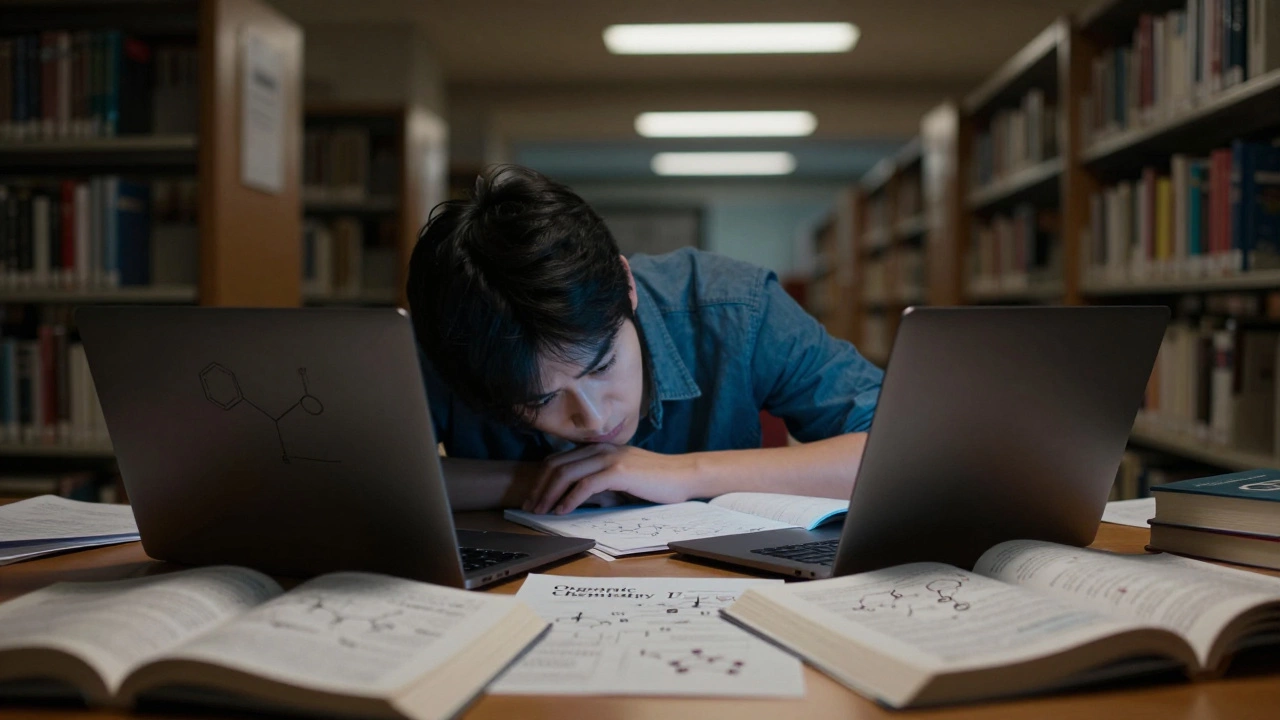
Organic Chemistry II is often cited as the ultimate gatekeeper for pre-med students. It builds directly on the first semester, meaning if you missed a concept early on, you’re drowning by week three. The material moves fast, covering reaction mechanisms, stereochemistry, and synthesis pathways. Students spend hours drawing molecular structures and predicting outcomes. The pressure comes from the fact that many medical schools use this grade as a primary filter. One bad grade here can derail years of planning.
Then there is Real Analysis. If you thought Calculus was tough, Real Analysis takes those concepts and strips away the intuition. Instead of calculating derivatives, you prove why they exist using rigorous logic and epsilon-delta proofs. It’s abstract, dry, and unforgiving. Many engineering and math majors find themselves stuck here because it demands a level of precision that standard calculus doesn’t. It’s not about getting the right number; it’s about proving your reasoning is flawless.
For law students, Contracts I is the nightmare scenario. First-year law students face the "Socratic method," where professors cold-call students to dissect case studies in front of the entire class. You need to read hundreds of pages of dense legal text every night, identify key precedents, and argue both sides of a dispute. The stress isn’t just academic; it’s psychological. The fear of being put on the spot and failing to articulate a complex legal principle keeps many students awake at night.
The High School Gauntlet: AP Courses
High schoolers have their own version of hell, known as Advanced Placement (AP) classes. These are college-level courses taken before graduation. While they offer potential college credit, they come with a workload that rivals undergraduate studies.
AP Physics C: Mechanics is widely considered one of the toughest. Unlike AP Physics 1, which is algebra-based, Physics C requires calculus. You need to understand integration and differentiation to solve problems involving motion, energy, and momentum. The exam itself is notorious for its multi-part questions that test deep conceptual understanding rather than rote memorization. Students often report spending 10-15 hours a week just on homework for this single class.
Another contender is AP Calculus BC. It covers everything in AP Calculus AB plus additional topics like parametric equations, polar coordinates, and infinite series. The pace is relentless. Teachers try to cover two semesters of college material in one year. If you fall behind, catching up is nearly impossible. The final exam has a strict time limit, and the multiple-choice section penalizes guessing, adding another layer of anxiety.
Don’t underestimate AP United States History (APUSH). It sounds manageable, but the volume of content is staggering. You need to know dates, names, causes, and effects of events spanning over 400 years. The essay portion requires synthesizing vast amounts of information into coherent arguments under time pressure. Many students fail not because they don’t know the facts, but because they can’t structure their thoughts quickly enough.

Why Do Some Classes Feel Impossible?
It’s not just the content. Several factors contribute to the perception of difficulty:
- Pacing: Covering a semester’s worth of material in six weeks leaves no room for confusion.
- Grading Curves: In large university lectures, professors may curve grades strictly to maintain statistical distribution, meaning even good performance might result in a B.
- Lack of Support: Introductory classes often have huge enrollments, making it hard to get help from professors or TAs.
- Prerequisite Gaps: If you didn’t master the basics in earlier classes, advanced topics become incomprehensible.

Survival Guide: How to Conquer the Hardest Classes
Knowing a class is hard doesn’t mean you should avoid it. In fact, tackling difficult subjects can boost your GPA if done right (since grading curves often favor those who push through). Here’s how to handle the pressure:
- Start Early: Don’t wait until the night before. Read the material before the lecture so you can follow along instead of scrambling to take notes.
- Form Study Groups: Explaining concepts to peers helps solidify your own understanding. Plus, sharing the workload makes it less overwhelming.
- Office Hours Are Non-Negotiable: Go to your professor’s office hours regularly. Ask questions, clarify doubts, and build rapport. This shows initiative and can sometimes influence borderline grades.
- Focus on Concepts, Not Memorization: Especially in sciences and math, understanding the "why" matters more than memorizing formulas. Practice applying concepts to new problems.
- Manage Your Time: Use a planner to block out study sessions. Treat studying like a job with fixed hours.
Is It Worth It?
Yes. Employers and graduate schools look for rigor in your transcript. Taking and succeeding in a notoriously difficult class signals resilience, intelligence, and work ethic. It tells them you can handle pressure and learn complex systems. While the experience might be painful, the long-term benefits often outweigh the short-term stress.
Remember, the "hardest" class is also the most rewarding when you finally grasp the material. That moment of clarity-when a complex proof clicks or a chemical reaction makes sense-is addictive. Embrace the challenge, prepare strategically, and don’t let the reputation scare you off.
What is the hardest AP class in America?
AP Physics C: Mechanics and AP Calculus BC are frequently cited as the hardest due to their reliance on advanced mathematics and rapid pacing. AP US History is also challenging because of the massive volume of content required for essays.
Why is Organic Chemistry considered so difficult?
Organic Chemistry requires visualizing 3D molecular structures and understanding complex reaction mechanisms. It builds sequentially, so missing early concepts makes later topics impossible to understand. High stakes for pre-med tracks add significant pressure.
Do harder classes hurt my GPA?
Not necessarily. Many colleges weight AP or honors classes, giving extra points for higher grades. Even without weighting, earning a B in a rigorous course can look better to admissions officers than an A in an easy one, as it demonstrates academic courage.
How can I succeed in a class everyone says is impossible?
Success comes from consistent effort. Attend every lecture, form study groups, visit office hours weekly, and start assignments immediately. Focus on understanding core concepts rather than cramming facts. Manage your stress through proper sleep and breaks.
Is Real Analysis really harder than Calculus?
Yes, for most students. Calculus focuses on computation and application, while Real Analysis focuses on rigorous mathematical proofs. It requires a different way of thinking, shifting from solving problems to proving why solutions are valid, which is much more abstract.