Coding Math Requirements Calculator
Find What Math You Need
Select your coding interest to see what math knowledge you'll need. Most paths require very little advanced math.
You’re sitting there, staring at a blank screen, thinking: Do I need to be good at math to code? Maybe you struggled with algebra in school. Maybe you avoided calculus like the plague. Now you want to learn to code, but that old fear is whispering in your ear: “You’re not a math person. You’ll never make it.” Let’s cut through the noise. The truth? Most coding doesn’t need advanced math - and you don’t need to be a math genius to build apps, websites, or even AI tools.
What Kind of Coding Actually Needs Math?
Not all coding is the same. Some areas rely heavily on math. Others? Barely touch it. If you’re building a video game with realistic physics, working on machine learning models, or designing financial trading algorithms - yes, you’ll need linear algebra, calculus, or statistics. But that’s less than 5% of all coding jobs.Most developers work on things like:
- Building websites with HTML, CSS, and JavaScript
- Creating mobile apps using Flutter or React Native
- Writing scripts to automate tasks like file organization or data backups
- Setting up servers and managing databases
- Fixing bugs in existing software
For these? You need logic, not formulas. You need to think step-by-step, not solve integrals. You need to understand how data flows - not calculate derivatives.
What You Actually Need: Logical Thinking
Coding is less about numbers and more about patterns. It’s like solving a puzzle. You break a big problem into smaller pieces. You figure out what happens if the user clicks here, or if the server goes down, or if the input is empty. That’s logic. That’s structure. That’s the real core of programming.Think of it like cooking. You don’t need to know the chemistry of Maillard reactions to make a good stir-fry. You just need to know: heat the pan, add oil, toss in garlic, wait, then add veggies. Same with code. You learn the steps. You follow the flow. You test what works.
People who say “you need math to code” are often mixing up two things: what math can help with and what you must know to start. You don’t need to know trigonometry to build a to-do list app. But if you later want to make a weather app that shows wind direction on a map - then trigonometry becomes useful. And you can learn that when you need it.
Real Stories: People Who Learned to Code Without Being “Math People”
In Bangalore, I’ve seen dozens of people start coding with zero confidence in math. One woman, Priya, dropped out of engineering because she hated calculus. At 28, she took a free online course in HTML and CSS. Six months later, she was building landing pages for local small businesses. She didn’t touch a single equation.A man named Raj, a former electrician, learned Python to automate his shop’s inventory. He didn’t know what a variable was six months ago. Now he writes scripts that track stock levels and send alerts when supplies run low. He never solved for x. He just learned: if stock < 10, then send email.
These aren’t outliers. They’re normal people who found a path that didn’t require them to relive their high school nightmares.
What Math Skills Are Actually Helpful (and When)
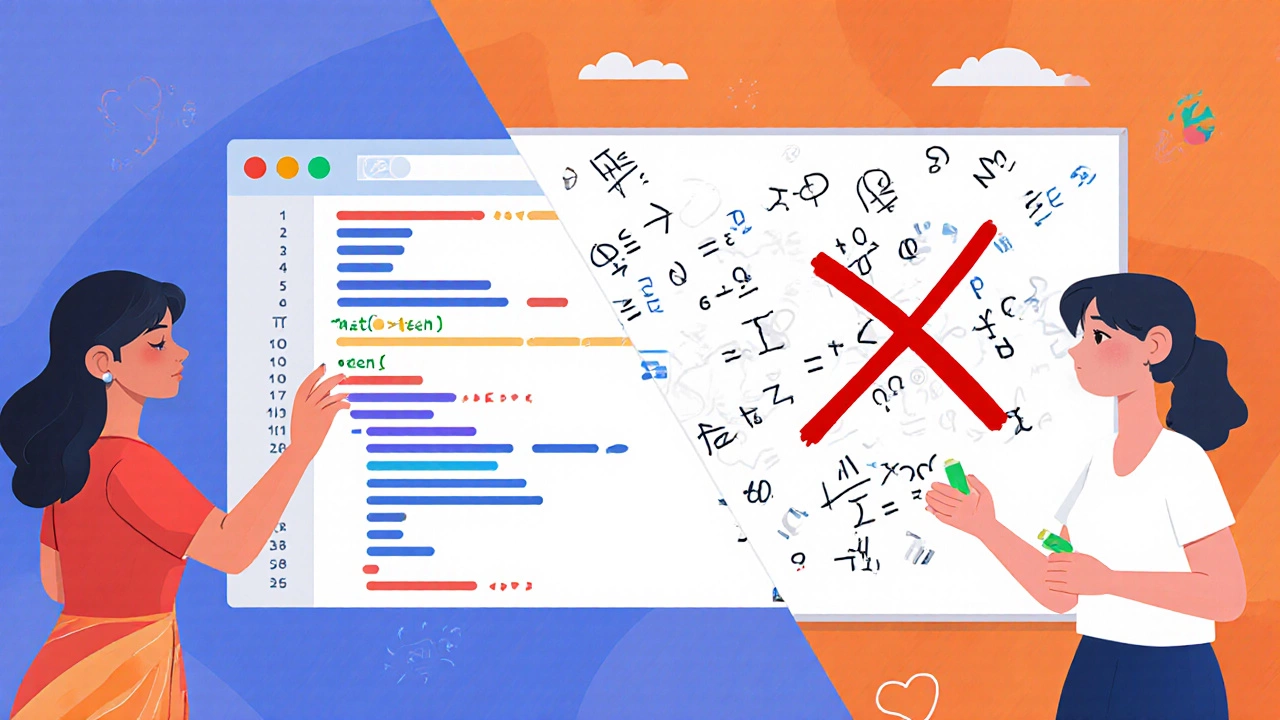
There’s no harm in knowing a little math - it can make some things easier. But you don’t need it upfront. Here’s a realistic breakdown:- Basic arithmetic - addition, subtraction, multiplication, division. You’ll use this daily. Even beginners need to count loops or calculate percentages.
- Logic and Boolean algebra - true/false, AND/OR/NOT. This is everywhere in code. It’s not math class logic - it’s decision-making logic. You already use this when you think: “If it’s raining, take an umbrella.”
- Basic statistics - mean, median, percentages. Useful if you’re analyzing user data or A/B testing buttons on a website.
- Algebra - variables and solving for unknowns. Helpful for understanding how functions work. But you don’t need to solve quadratic equations.
- Calculus, linear algebra, advanced stats - only needed for data science, graphics, AI, or game engines. Skip these until you’re sure you’re heading that way.
Most coding bootcamps and beginner courses teach you exactly what you need - nothing more. No one asks you to derive the chain rule on day one.
Why the Myth Persists
The idea that coding requires advanced math comes from a few places:- Computer science degrees often start with heavy math courses - but that’s because they’re training researchers, not web developers.
- Early programming books were written by academics who assumed you’d be doing theoretical work.
- People who do math-heavy coding tend to talk loudly about it - making it seem like everyone needs it.
The truth? The tech industry needs builders more than theorists. Companies don’t hire you to solve equations. They hire you to solve problems. And most problems don’t need a calculator.
Where to Start - No Math Required
If you’re ready to begin, here’s a simple path:- Start with HTML and CSS. Build a simple personal page. No code needed beyond copying and tweaking.
- Move to JavaScript. Make a button that changes color when clicked. That’s programming - no numbers involved.
- Try Python. Write a script that renames 100 files in a folder. Or sends a text reminder every morning.
- Use free platforms like freeCodeCamp, The Odin Project, or Codecademy. They teach you by doing - not by lecturing on math.
Within three months, you’ll have built real things. You’ll feel confident. And you’ll realize: I didn’t need to be good at math. I just needed to be patient and curious.

What If You Want to Go Deeper?
Maybe you start building a game. Or you get interested in AI. Or you want to work at a fintech startup. That’s great. When you hit a wall because you don’t understand how matrices work or what a gradient is - then learn the math. But now you have a reason. Now it’s not abstract. Now it’s tied to something you care about.That’s how real learning happens. Not by studying math for months before writing a single line of code. But by coding first, and filling in the gaps as you go.
You Don’t Need to Be Perfect - Just Persistent
The biggest barrier to learning code isn’t math. It’s fear. Fear that you’re too old. Too slow. Too unskilled. Too far behind.You don’t need to be the smartest person in the room. You just need to show up. To try. To fail. To try again. Thousands of people have done it - without ever loving math. You can too.
Code is a tool. Not a math test. And like any tool, you learn it by using it - not by memorizing formulas.
Do I need a degree in math to become a programmer?
No. Most programmers don’t have math degrees. Many don’t even have computer science degrees. Employers care more about what you can build than what classes you passed. Bootcamps, online courses, and personal projects are now the main paths into tech jobs.
Can I learn to code if I failed math in school?
Absolutely. Many successful developers struggled with math in school. Coding is about problem-solving, not calculation. If you can follow instructions, think logically, and stay patient, you can learn to code - even if you still don’t like fractions.
What if I want to work in AI or data science?
Those fields do require more math - statistics, linear algebra, probability. But you don’t need to master it before you start. Learn the basics of Python first. Then, as you work on real projects, learn the math you need. Most people pick up the math while building models, not before.
Is coding harder than math?
It’s different, not harder. Math is about finding the one right answer. Coding is about finding a working solution - and there are often dozens of them. You can be creative. You can experiment. You can fail and try again. That’s why many people find coding more satisfying.
How much math do I need for web development?
Almost none. Web developers use basic arithmetic for layout calculations (like percentages or spacing), and logic for form validation. You won’t need calculus, trigonometry, or algebra beyond simple variable use. Tools handle the complex math for you.
Next Steps: Start Today
Don’t wait until you’re “ready.” You’ll never feel ready. Pick one free resource - freeCodeCamp’s Responsive Web Design course, or Codecademy’s Learn HTML. Spend 20 minutes a day. Build something small. Break it. Fix it. Do it again. In a month, you’ll look back and wonder why you ever thought math was the barrier.The only thing you need to be good at to code? Keeping going.