School Board Suitability Calculator
Tell us about your goals:
Your Result
Answer the questions above to see which school board aligns best with your needs.
When you ask which school is very popular in India, you are likely looking for more than just a name. You want to know the system that shapes millions of students every year. The answer isn't a single building or campus. It is the Central Board of Secondary Education, commonly known as CBSE. This board dominates the Indian educational landscape, influencing everything from daily classroom routines to high-stakes national exams.
The CBSE syllabus is not just a list of topics. It is the backbone of academic life for over 30 million students across the country and abroad. If you are a parent planning your child's future, or a student trying to understand the pressure cooker of Indian schooling, knowing how this system works is essential. Let's break down why this specific board holds such power and what it means for you.
The Scale of CBSE Dominance
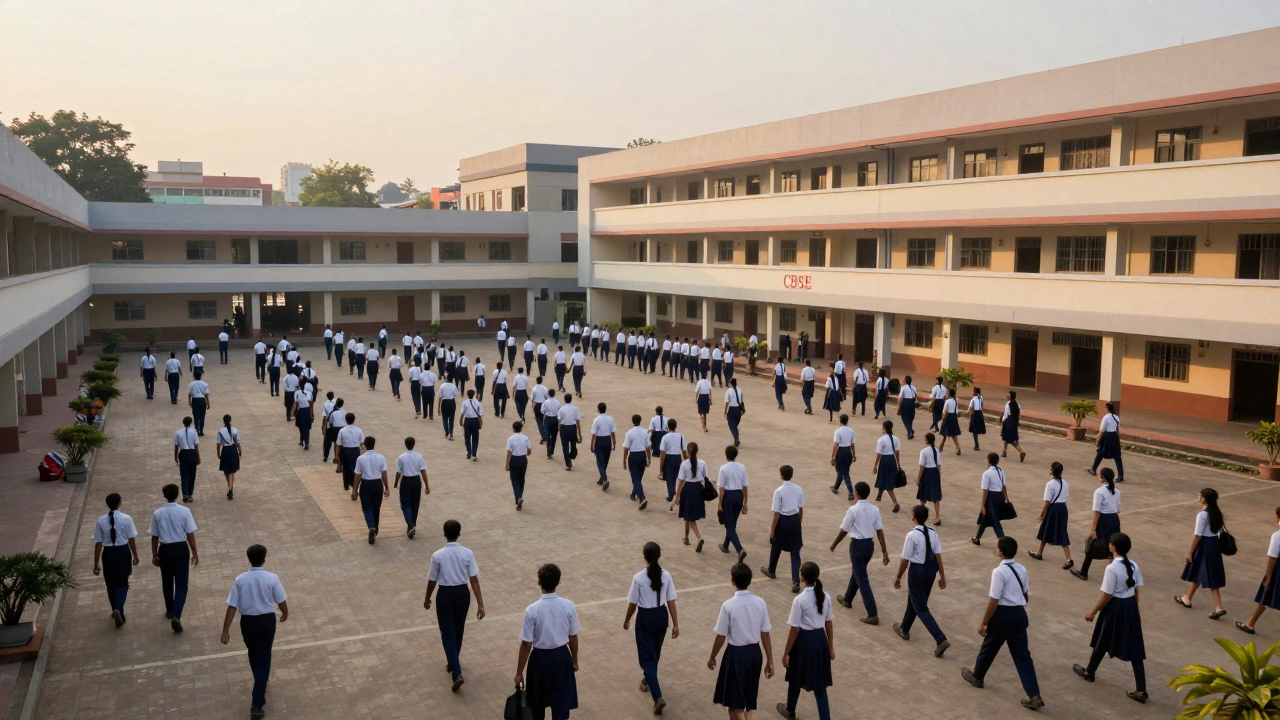
To understand popularity, look at the numbers. The Central Board of Secondary Education operates under the Ministry of Education in India. As of recent data, it oversees more than 28,000 affiliated schools within India and thousands more in over 30 countries, including the UAE, USA, and UK. No other board comes close to this reach.
Why does this matter to you? Because where there are many students, there are resources. Textbooks, coaching centers, online tutorials, and study materials are all built around the CBSE curriculum. If you switch to a less common board, you might find yourself searching harder for help when you get stuck on a physics problem or a history essay. With CBSE, the ecosystem is ready-made.
- National Reach: Present in almost every district of India.
- Global Presence: Strong network for expatriate families.
- Resource Availability: Highest volume of study aids and apps.
How the CBSE Syllabus Shapes Learning
The core of any school's reputation lies in its teaching method. The CBSE syllabus follows a structured approach aligned with the National Curriculum Framework (NCF). It emphasizes conceptual clarity over rote memorization, though the reality often feels different due to competitive pressures.
In subjects like Mathematics and Science, the board focuses on application-based learning. For example, instead of just asking you to calculate an area, questions often present real-world scenarios where you must decide which formula applies. This shift aims to prepare students for higher education and technical careers.
However, the syllabus is dense. Students in Class 10 and Class 12 face rigorous annual examinations. These aren't just tests; they are gateways. Your scores in these final years directly impact your eligibility for top engineering and medical colleges through entrance exams like JEE and NEET. This link between school performance and career prospects makes the board incredibly serious business.
CBSE vs. ICSE: The Main Rivalry
If CBSE is the most popular, who is its biggest competitor? The Indian Certificate of Secondary Education, or ICSE, run by the Council for the Indian School Certificate Examinations (CISCE). While CBSE wins on quantity, ICSE often claims quality in terms of language skills and detailed content.
Here is how they stack up against each other in key areas:
| Feature | CBSE | ICSE |
|---|---|---|
| Focus Area | Science and Math heavy | Balanced with strong English/Literature |
| Exam Pattern | Annual, standardized nationwide | Internal assessments + Final exam |
| Syllabus Depth | Concise, exam-oriented | Detailed, comprehensive |
| Best For | Students aiming for IIT/JEE/NEET | Students interested in Arts, Humanities, or Abroad |
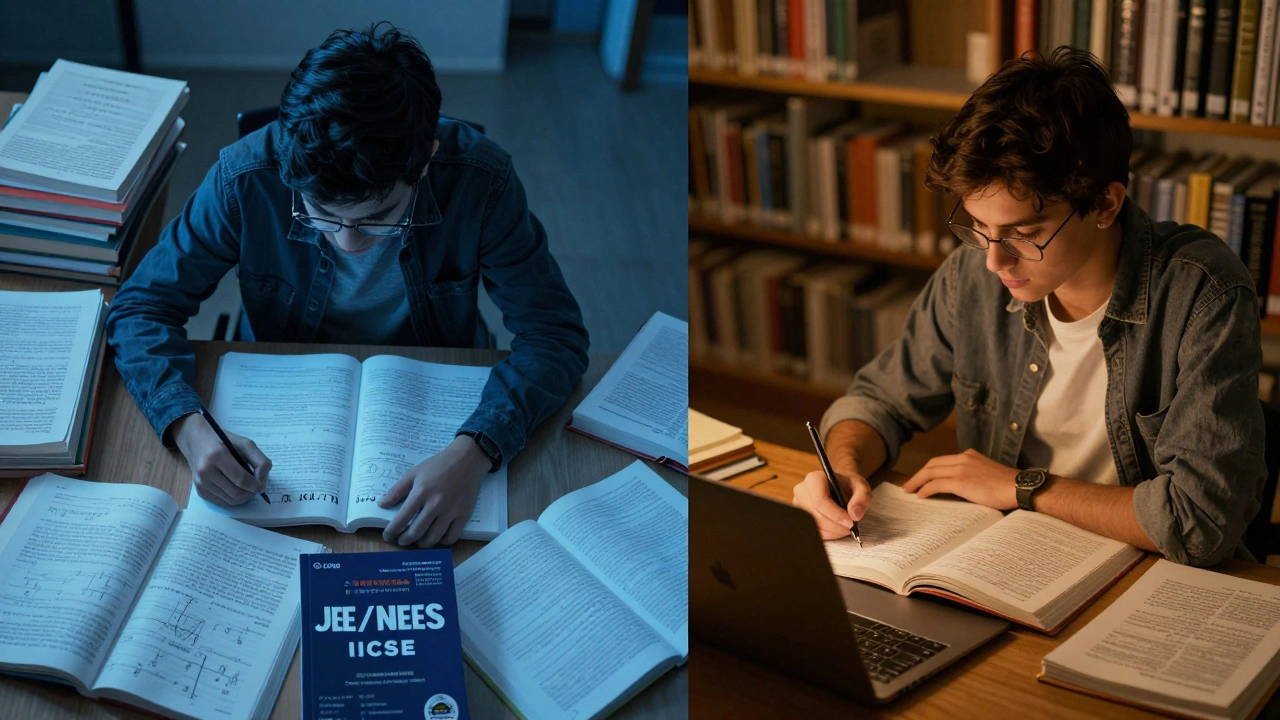
If your goal is to crack competitive engineering exams in India, CBSE is usually the preferred path. Its syllabus aligns closely with the pattern of JEE Main. ICSE, on the other hand, demands more writing and analytical thinking, which can be beneficial if you plan to pursue liberal arts or apply to universities in the UK or Australia.
The Role of State Boards
You cannot talk about Indian schools without mentioning state boards. Each state has its own board, such as Maharashtra State Board or Tamil Nadu State Board. Collectively, they have more students than CBSE. However, they lack the unified national brand recognition.
State boards are deeply connected to local culture and languages. They offer instruction in regional tongues, making them accessible to millions who might struggle with English-medium instruction. Yet, when parents talk about "popular" schools in urban centers, they often mean private institutions following CBSE. Why? Because mobility. A CBSE student moving from Delhi to Bangalore faces minimal disruption. A state board student might need to adapt to a completely new curriculum.
Why Private Schools Choose CBSE
Most of the well-known private schools in India-like Delhi Public School (DPS), Kendriya Vidyalaya (KV), and various international chains-are affiliated with CBSE. This affiliation drives popularity. Parents trust the brand. They know that a degree from a DPS campus carries weight regardless of location.
Kendriya Vidyalayas, originally set up for children of defense and government employees, have become models of affordable, high-quality education. Their strict adherence to the central syllabus ensures consistency. If you live near a KV, it is often considered one of the best options due to low fees and disciplined environments.
Challenges Within the System
Popularity doesn't mean perfection. The CBSE system faces criticism for being too exam-focused. The pressure to score high marks in Class 10 and 12 can lead to significant stress among teenagers. Mental health issues related to academic pressure are a growing concern.
Additionally, the "one-size-fits-all" approach sometimes ignores creative talents. If you are brilliant at music or sports but average in math, the traditional grading system may not highlight your strengths enough. Recent reforms under the New Education Policy (NEP) 2020 aim to fix this by introducing flexible subject choices and vocational training earlier in the school years.
What Should You Choose?
If you are deciding which school to join, ask yourself these questions:
- Where do you see yourself in five years? If it's an engineering college in India, stick with CBSE.
- How is your English proficiency? If you prefer deeper literary analysis, consider ICSE.
- Do you plan to move cities? CBSE offers the smoothest transition.
- What is your budget? Government-affiliated schools like KV and Navodaya Vidyalaya offer excellent value compared to expensive private CBSE schools.
The "most popular" choice is safe because it is proven. But the "best" choice depends on your individual goals. Don't just follow the crowd. Look at the syllabus documents, talk to current students, and assess the school's infrastructure before signing up.
Is CBSE better than ICSE for engineering students?
Yes, generally. The CBSE syllabus aligns closely with the JEE Main examination pattern, making it easier for students to prepare for both school finals and engineering entrance tests simultaneously. ICSE requires more time on theory and literature, which might divert focus from STEM subjects.
Can I switch from a State Board to CBSE in Class 11?
You can, but it is challenging. The gap between state boards and CBSE can be significant, especially in science and mathematics. You may need to take extra classes to catch up. It is usually easier to switch during middle school (Class 8-9) rather than senior secondary.
Are Kendriya Vidyalaya schools free?
They are highly subsidized. While not completely free, the fees are nominal compared to private schools. They are primarily meant for children of transferable government employees, but admissions are open to others based on availability and distance criteria.
Does the CBSE board conduct exams in regional languages?
Yes. CBSE allows students to take exams in several Indian languages, including Hindi, Bengali, Marathi, Tamil, and Telugu, depending on the region and school facilities. However, English remains the most common medium of instruction.
How has the New Education Policy 2020 affected CBSE?
The NEP 2020 has introduced multidisciplinary approaches, allowing students to mix subjects (e.g., studying Physics with History). It also emphasizes critical thinking over rote learning and has reduced the syllabus load to focus on foundational concepts.