CBSE Question Style Explorer
Explore CBSE Question Differences
Select a topic to see how it's tested differently in Delhi vs. other states
Question Style Comparison
Every year, students across India sit for the same CBSE board exams. But if you’re in Delhi, you might notice something strange - the question papers look different. Not just slightly different. Actually, CBSE paper in Delhi is often harder, longer, or even has different types of questions than what students in other states get. Why? It’s not a mistake. It’s by design.
CBSE Doesn’t Have One Single Paper for Everyone
Many people assume CBSE, like a national exam board, gives the exact same paper to every student. That’s not true. CBSE follows a system where it releases multiple sets of question papers - usually four or five - for each subject. These are labeled Set 1, Set 2, Set 3, and so on. Each set has different questions, but they’re meant to test the same concepts at the same difficulty level.But here’s the catch: Delhi gets a special treatment. In many subjects, especially core ones like Mathematics, Science, and English, Delhi students receive a paper that’s not just one of the standard sets. It’s a separate, region-specific version. This isn’t random. It’s because Delhi has its own Regional Office under CBSE, called the Delhi Region. It’s one of the 10 regional offices of CBSE, and it has the authority to design its own question papers for internal administrative reasons.
Why Does Delhi Need Its Own Paper?
The main reason is security. Delhi is the national capital. It’s home to thousands of government schools, coaching centers, and high-profile institutions. It’s also the center of political and media activity. In the past, leaked question papers have caused major scandals - and Delhi has been the epicenter of most of them.For example, in 2017, a leaked Maths paper surfaced just hours before the exam in Delhi. The paper was identical to one circulating on WhatsApp groups. That incident led to CBSE re-examining how papers were handled in the capital. Since then, Delhi has been given a separate set of question papers that are printed and distributed under tighter security, often by different vendors and with different logistics than the rest of the country.
It’s not just about leaks. Delhi has a higher concentration of students who take coaching for competitive exams like JEE and NEET. Many of these students are exposed to advanced material earlier than their peers in other states. CBSE Delhi Region adjusts the paper to match this higher academic baseline. So while a student in Rajasthan might get a straightforward question on quadratic equations, a student in Delhi might get a multi-step word problem involving real-world applications - the kind you’d see in JEE Main.
It’s Not Just About Difficulty - It’s About Fairness
Some students and parents think the Delhi paper is unfair because it’s harder. But that’s not the full story. CBSE doesn’t aim to make Delhi’s paper harder. It aims to make it equivalent in terms of cognitive demand.Here’s how it works: CBSE uses a statistical method called equating. After the exams, they analyze the performance of students across all sets. If students in Delhi scored 15% higher on average, CBSE adjusts the marking scheme to ensure the final grades reflect the same level of achievement as students in other regions. So even if the Delhi paper is tougher, the passing rate and top scorers are kept in line with national trends.
This is why you’ll see students from Delhi and Tamil Nadu getting the same percentile rank, even if their raw scores differ. The board doesn’t care about raw marks - it cares about relative performance. That’s why CBSE publishes result sheets with percentile ranks, not just scores.
What Do the Papers Actually Look Like?
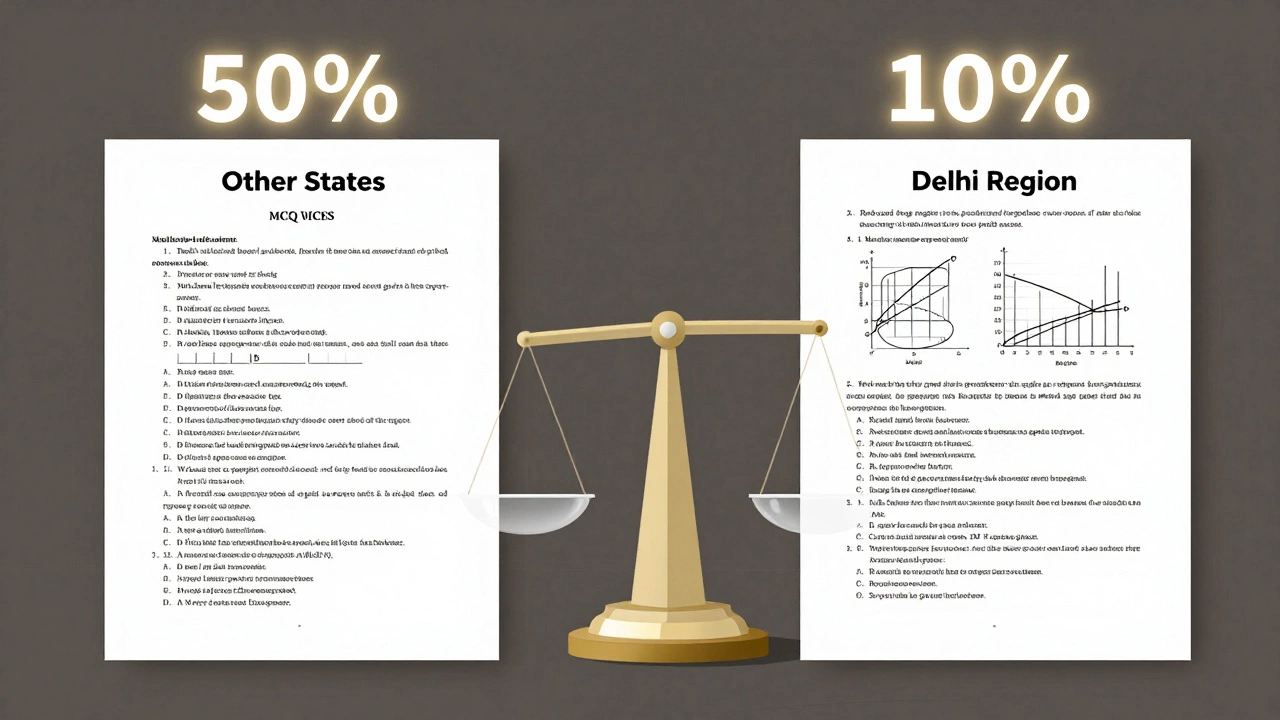
Let’s take Class 10 Science as an example. In a standard CBSE paper outside Delhi, you might see:- 10 one-mark MCQs
- 5 two-mark short answer questions
- 3 five-mark long answer questions
In Delhi, the same subject might have:
- 8 one-mark MCQs
- 8 two-mark questions with data interpretation
- 4 five-mark questions requiring diagram-based explanations and real-life applications
The topics are the same - photosynthesis, electricity, acids and bases - but the way they’re tested is different. Delhi’s questions often require deeper analysis, more application, and less rote memorization. That’s because the student population in Delhi is more exposed to analytical learning from an early age.
Other Regions Have Variations Too - Just Not as Noticeable
Delhi isn’t the only region with special handling. Jammu & Kashmir, for example, gets papers with fewer numerical problems in Maths due to infrastructure challenges in remote areas. Some northeastern states have slightly modified English papers to account for language diversity. But these adjustments are rarely publicized, and they don’t get the same media attention as Delhi’s.Delhi stands out because it’s the capital. It’s where the media, politicians, and coaching industries are most active. Any difference becomes a headline. But the system is the same: CBSE adapts papers to local student profiles, not to favor or disadvantage any region.
What Should Delhi Students Do Differently?
If you’re a student in Delhi preparing for CBSE, here’s what you need to know:- Don’t rely on old papers from other states. The pattern is different.
- Focus on application-based questions, not just memorization.
- Practice diagram-based and case-study questions - they’re common in Delhi papers.
- Use only CBSE Delhi Region sample papers and previous year papers released by the board’s Delhi office.
- Don’t panic if the paper feels harder. It’s designed to match your preparation level.
Many Delhi students assume they need to study extra-hard because the paper is tougher. But the truth is, they’re already ahead. The paper reflects their environment - schools here are more competitive, parents are more involved, and coaching is more accessible. The board isn’t trying to trick you. It’s just trying to keep up with you.
What About CBSE Class 12? Same Rules Apply
The same logic applies to Class 12. Whether you’re taking Physics, Chemistry, or Economics, Delhi students get a separate set of papers. The syllabus is identical. The marking scheme is identical. But the questions? They’re calibrated for a higher baseline of preparedness.For example, in Economics, a student in Uttar Pradesh might get a question asking them to define GDP. A Delhi student might get a question asking them to analyze how GDP growth affects income inequality using real data from the last five years. Same concept. Different depth.
And yes, CBSE still equates the results. So if you score 88% in Delhi and your friend scores 85% in Kerala, and both are in the top 1%, you’ll both get the same percentile. The board doesn’t care where you’re from. It cares about how well you performed relative to others in your region.
Is This System Fair?
It’s a fair system - if you understand how it works. It’s not about giving Delhi students an advantage. It’s about giving them a paper that matches their reality.Imagine if every student in India got the same paper, regardless of where they lived. A student in a village school with no lab equipment would be asked to explain experiments they’ve never seen. A student in Delhi, who’s done those experiments in a private school lab, would have an unfair advantage. That’s not fair.
CBSE’s system tries to level the playing field by adjusting the questions to match local learning environments. Delhi’s paper is harder because its students are better prepared. That’s not bias - it’s adaptation.
And if you’re worried about the pressure - you’re not alone. Many Delhi students feel the weight of this system. But remember: the board doesn’t expect perfection. It expects understanding. If you can explain why something happens, not just what it is, you’re already ahead.
Why does Delhi have a different CBSE paper than other states?
Delhi has a different CBSE paper because it’s managed by the CBSE Delhi Region, which handles exam security and paper design separately due to higher risk of leaks and a more advanced student profile. The syllabus is the same, but the questions are adjusted to match the higher academic exposure of students in the capital.
Is the CBSE paper in Delhi harder than in other states?
Yes, the questions are often more application-based and require deeper analysis, but that’s because Delhi students are generally better prepared due to access to coaching, better infrastructure, and more competitive schools. The board doesn’t make it harder to punish students - it makes it harder because they’re ready for it.
Do students in Delhi have an advantage in CBSE exams?
No, they don’t have an advantage in terms of final grades. CBSE uses a statistical process called equating to ensure that percentile ranks are consistent across regions. A student scoring 90% in Delhi and one scoring 87% in Gujarat can both be in the top 5% if their performance relative to their peers is the same.
Can I use CBSE papers from other states to prepare for Delhi exams?
You can use them for general concept practice, but don’t rely on them for pattern or question style. Delhi papers focus more on real-life applications, data interpretation, and diagram-based answers. Use only the official CBSE Delhi Region sample papers to prepare accurately.
Are there any other regions with special CBSE papers?
Yes, but they’re not as publicized. Jammu & Kashmir, some northeastern states, and even parts of Gujarat have modified papers to suit local conditions - like language barriers or lack of lab facilities. But only Delhi’s changes attract national attention because of its political and media significance.