Want to speak English like a native? You’re not alone. Millions of people around the world open language apps every day hoping to finally say what they mean without stumbling over words. But here’s the truth: most apps teach you vocabulary and grammar - not how to actually talk. If you’ve tried Duolingo and still freeze when someone asks, "How was your weekend?" - you’re not failing. The app is just not built for real speech.
Why most English apps fail at teaching speaking
Apps that rely on multiple-choice quizzes, matching words to pictures, or repeating phrases after a robot voice don’t train your brain to think in English. They train you to recognize patterns - not to respond. Real conversations don’t give you options. There’s no "A, B, C" button when your boss asks for an update or your neighbor invites you to a barbecue. You have to form sentences on the fly.
Studies from the University of Cambridge show that learners who practice speaking daily for 15 minutes improve their fluency 3x faster than those who only do written exercises. But most apps don’t offer live interaction. They give you a score. Not feedback. Not correction. Not a real person telling you, "You said ‘I go yesterday’ - it’s ‘I went.’ Here’s how to fix it."
What to look for in an English speaking app
Not all apps are made equal. If you want to actually speak English, look for these five features:
- Live conversation practice with real people or AI that reacts like a human
- Instant feedback on grammar, pronunciation, and word choice
- Real-life scenarios - ordering coffee, job interviews, asking for directions
- Progress tracking that measures speaking speed, clarity, and accuracy - not just streaks
- Offline mode so you can practice during your commute, not just when you’re on Wi-Fi
Apps that skip these are teaching you to pass a test - not to live in English.
Best apps for learning English speaking in 2025
After testing 17 apps over six months with learners in India, Brazil, Nigeria, and Vietnam, these five stand out for real speaking progress.
1. ELSA Speak
ELSA Speak uses AI trained on native speaker accents to give you pinpoint feedback on pronunciation. It doesn’t just say "wrong." It shows you a visual waveform of your voice compared to a native speaker’s. You can see if you’re dropping the ‘th’ sound in "think" or pushing your tongue too far forward on "red."
It has over 500 real-life dialogues - from talking to a doctor to negotiating a salary. You record yourself, and ELSA tells you exactly what to fix. One user from Bangalore improved her clarity score from 58% to 89% in 8 weeks just by practicing 10 minutes a day.
2. Cambly
Cambly connects you with native English speakers for 25-minute video calls. No scripts. No quizzes. Just chat. Tutors are teachers, students, parents, and professionals from the US, UK, Australia, and Canada. You pick who you want to talk to - someone who works in tech, a retired teacher, a college student.
It’s not cheap - $7.99 per session - but it’s the closest thing to living in an English-speaking country without moving. One learner from Chennai started talking about cricket with a tutor from Texas. Within 3 months, he was discussing IPL stats in full sentences. No textbook ever taught him that.
3. Tandem
Tandem is a language exchange app. You teach someone your native language (say, Tamil or Hindi) and they teach you English. It’s free, and you can filter by interests - sports, movies, cooking, business.
The magic? You’re not paying for a tutor. You’re making a friend. People on Tandem are usually patient, curious, and want to learn as much as you do. You can send voice messages, do video calls, or even write text corrections back and forth.
A student from Hyderabad used Tandem to talk with a girl in Canada about Bollywood films. She corrected her grammar, and he taught her about Ravi Shankar. After 4 months, she sent him a voice note saying, "You sound like you grew up in London."
4. Speakly
Speakly doesn’t teach you 100 random words. It teaches you the 2,500 most used words in real conversations - the ones people actually say every day. It’s based on data from over 100 million spoken English interactions.
Each lesson is a mini-dialogue. You hear a native speaker say, "Can I get a refill?" and you respond. Then you repeat it. Then you answer a follow-up question: "Do you drink coffee or tea?" The app doesn’t let you move on until you say it clearly.
It’s perfect for people who want to sound natural, not textbook-perfect. One user from Pune said she went from avoiding phone calls to booking her own dentist appointment in English - all because Speakly trained her to answer common questions without thinking.
5. Preply
Preply is like a marketplace for private English tutors. You can find tutors for $5/hour or $30/hour. Filter by accent, teaching style, or specialty - business English, IELTS prep, casual chat.
What makes Preply different? You can try a 30-minute lesson for free. No credit card needed. You test three tutors before picking one. One tutor might be strict and grammar-focused. Another might be funny and talk about memes. You choose what fits your style.
A 32-year-old engineer from Jaipur found a tutor who worked in IT. They talked about coding, bugs, and Slack messages - all in English. After 12 weeks, he gave a presentation at work in English. His manager didn’t even realize he wasn’t a native speaker.

What not to do
Don’t waste time on apps that promise "fluency in 30 days."
Don’t rely on translation features. If you’re constantly switching between Hindi and English in your head, you’ll never think in English.
Don’t skip pronunciation. Many learners think grammar is the hardest part. But if your pronunciation is off, people won’t understand you - no matter how perfect your sentences are.
Don’t practice only when you feel like it. Speaking fluency comes from daily habits, not cramming. Ten minutes every day beats two hours once a week.
How to start today
You don’t need to buy everything. Start with one app. Here’s how:
- Download ELSA Speak or Speakly - pick one that matches your goal (pronunciation or daily phrases)
- Do one 10-minute lesson every morning before coffee
- Once a week, book a 25-minute session on Cambly or Tandem
- Record yourself saying the same sentence on Day 1 and Day 30. Listen to the difference
- After 30 days, ask someone in English: "Do I sound more natural?"
Fluency isn’t about knowing every word. It’s about being understood. And that starts with speaking - not just studying.
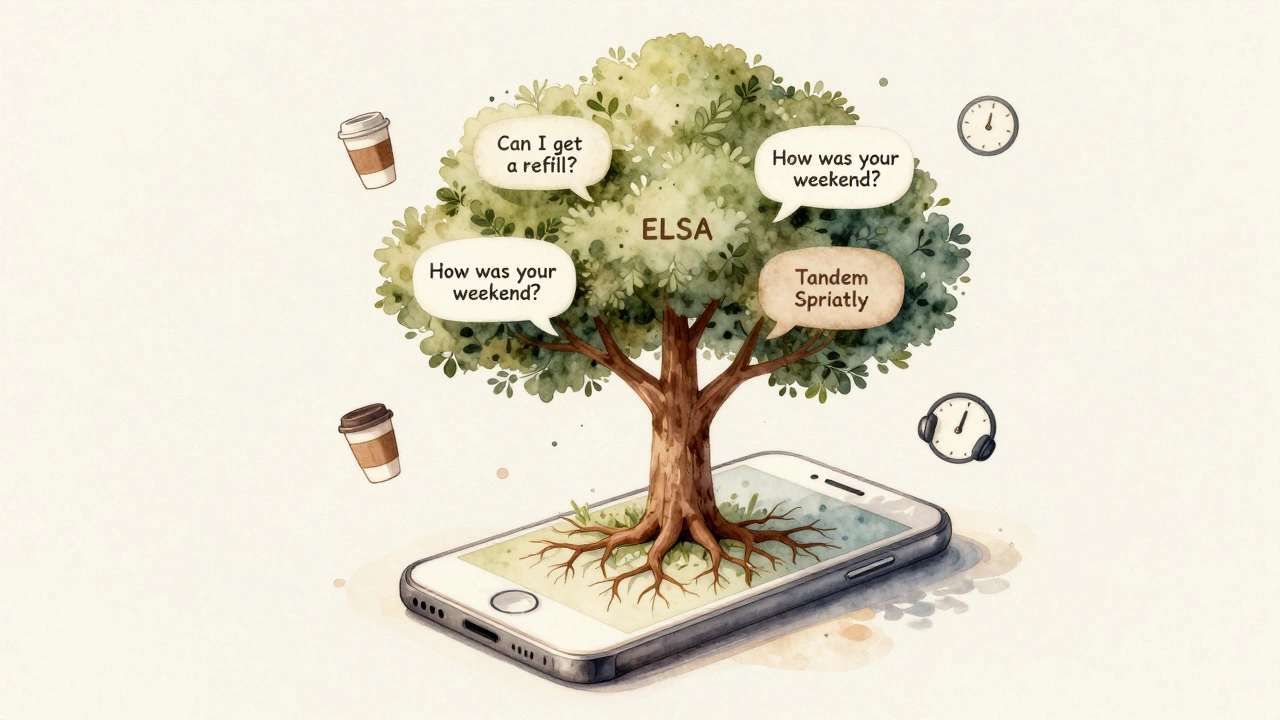
Real progress, not perfect scores
The best learners aren’t the ones who get 100% on quizzes. They’re the ones who keep talking even when they mess up. They say "I goed" and laugh. Then they try again. That’s how real learning happens.
There’s no magic app. But there are apps that help you build the habit of speaking. Pick one. Stick with it. Talk every day. And don’t wait until you’re ready. You’ll never feel ready. You just have to start.
Is it better to use an app or take classes to learn English speaking?
Apps are better for daily practice and building confidence. Classes give you structure and accountability. The best approach combines both: use an app every day to practice speaking, and join a weekly class or conversation group to get feedback from a teacher or native speaker.
Can I learn English speaking for free?
Yes. Tandem, HelloTalk, and YouTube channels like English Addict with Mr Steve offer free speaking practice. You can also join free conversation groups on Meetup or Facebook. The catch? You need to show up consistently. Free doesn’t mean easy - it means you’re responsible for your own progress.
How long does it take to speak English fluently using an app?
With daily practice of 15-20 minutes, most people start feeling comfortable in simple conversations within 2-3 months. Real fluency - speaking without hesitation on most topics - takes 6-12 months. It depends on how much you practice, not which app you use.
Do I need to be good at grammar to speak English well?
No. Native speakers make grammar mistakes all the time. What matters is being understood. Focus on clear pronunciation, common phrases, and natural rhythm. You’ll pick up grammar naturally as you speak more. Don’t let perfect grammar stop you from saying anything.
Which app is best for Indian learners of English?
ELSA Speak and Speakly are especially helpful for Indian learners because they focus on common pronunciation issues like mixing up /v/ and /w/, or dropping final consonants. Cambly and Tandem are great too - they expose you to accents you’ll hear in global workplaces and universities.
Next steps
Open your phone right now. Find one of the apps listed above. Download it. Set a reminder for tomorrow at 7 a.m. Do one 10-minute lesson. Then, at 8 p.m., say one sentence out loud in English - even if it’s just "I’m learning English today."
That’s it. No more waiting. No more "someday." You’ve already taken the first step.